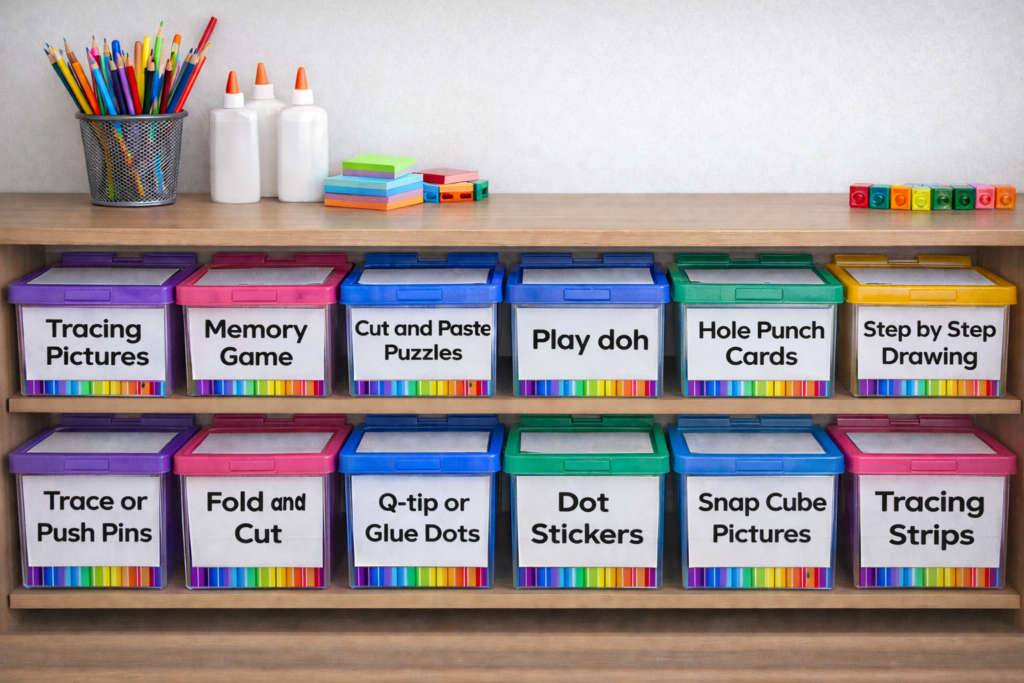
Time is short in most classrooms and therapy rooms. It always has been. The good news is that fine motor work doesn’t require laminating stations, specialty kits, or hours of prep. Hand strength, pencil control, and dexterity can grow just fine with everyday materials many of us have used for decades—paper, pencils, scissors, and simple classroom tools.
Fine motor skills help children participate more fully in school—writing, cutting, building, organizing, and handling classroom materials. Occupational therapy practitioners have long noted that regular practice with small-hand movements helps students become more comfortable with handwriting, visual-motor tasks, and everyday routines. When these tasks are repeated over time, children tend to show improvements with grasp, coordination, endurance, and confidence.
This post shares 20 no-prep fine motor activities you can use tomorrow—whether you’re a classroom teacher, occupational therapy practitioner, or someone supporting learning at home.
What Are Fine Motor Skills?
Fine motor skills involve the small, precise movements of the hands and fingers.
They’re used for:
- Writing
- Cutting
- Tying shoes
- Buttoning
- Manipulating school tools
- Everyday self-help tasks
These skills rely on a mix of:
- Hand strength
- Finger dexterity
- In-hand manipulation
- Bilateral coordination
- Visual-motor integration
- Basic motor planning
Steady practice—especially through simple, meaningful activities—helps these abilities develop over time.
Why These Activities Matter
No-prep fine motor activities are helpful because they:
- Fit easily into busy days
- Reinforce pencil control and hand strength
- Support scissor skills and coordination
- Encourage visual attention and sequencing
- Promote independence with classroom tasks
Short sessions, done consistently, can make a noticeable difference. It doesn’t have to be complicated.
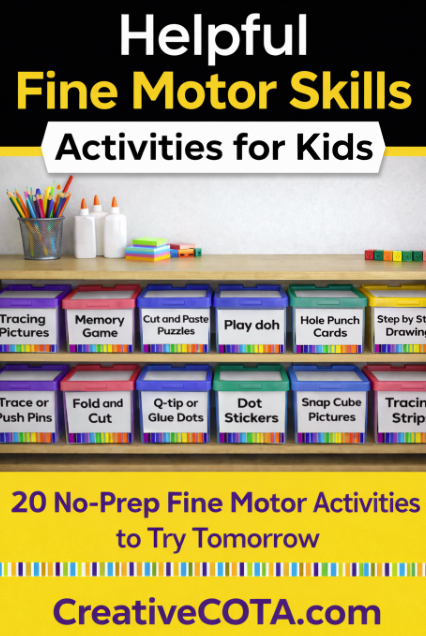
20 No-Prep Fine Motor Activities
Below are simple ideas you can use right away. Most take only a few minutes and require common classroom materials.
Paper & Pencil Tasks
- Dot-to-Dot Pages
- Mazes (printed or hand-drawn)
- Rainbow Writing (trace with different colors)
- Box-and-Dot Letter Formation
- Simple Graphing (favorite colors, animals, etc.)
OT note:
Tracing, drawing paths, and repeated pencil movements help support visual-motor integration and pencil control.
Cutting Tasks
- Straight-Line Cutting or Snipping with Scrap Paper
- Snip & Drop (short strips into a bin)
- Cut + Sort Magazine Pictures
- Cut-and-Paste Disguise a Picture: Students can cut up and cover any simple coloring page with paper
- Shape Hunts (cut only circles, etc.)
OT note:
Cutting encourages bilateral coordination and helps build small intrinsic hand muscles.
Simple Manipulation Tasks
- Crumple-and-Toss with Scrap Paper-snowball fight in the Winter
- Paperclip Chains
- Paper Folding (halves/quarters): advanced make origami, paper airplanes…
- Ripped Paper Crafts: works on finger tip isolation
- Cheerios or beads on Pipe Cleaners
OT note:
Small manipulation tasks strengthen separation of the hand, helpful for handwriting endurance and control.
Classroom Object Tasks
- Sticker Path Tracing: Place stickers along a path.
- Post-It Pickup (one finger only)
- Clothespin Number Match: Write numbers on to the clothes pins and clip on to a ruler
- Paper-Clip Sorting: Sort colored clips onto matching paper
- Mini-Eraser sorting: sort by color or stack
OT note:
Activities like pinching, placing, and sorting help support pincer grasp patterns used for writing and tool use.
Why is it Important?
Many classroom routines rely on fine motor skill development. Occupational therapy practice, supported by decades of child development research, shows that regular practice with small-hand tasks helps children build stronger hands, steadier pencil control, and better participation in handwriting and classroom tool use.
When students regularly engage in short, hands-on tasks; tracing, cutting, pinching, sorting, folding, they gradually improve:
- Hand strength
- Finger dexterity
- Visual-motor integration
- Bilateral coordination
These abilities support smoother handwriting, neater work on paper, and more confidence with everyday school tasks. It doesn’t take bells and whistles. Consistency is what moves the needle.
Small, simple tasks, repeated throughout the week, have always been a reliable foundation.
When to Use These Activities
These ideas fold into daily routines with very little effort:
- Morning work
- Small-group occupational therapy sessions
- Early-finisher bins
- Learning centers
- Sub plans
- Home packets
- After-school programs
Pick one or two that feel doable and sprinkle them into your week.
Tips to Make It Run Smoothly
- Keep a small bin of basic supplies handy
- Model once, then let students practice
- Keep directions short and visual
- Repeat activities so students can grow their skills over time
- Adjust difficulty by adding or removing steps
Students don’t need a brand-new activity every day. Repetition builds coordination and confidence.
Fine motor skills grow with small, consistent practice—often through the same quiet activities many of us remember from childhood. A few minutes of cutting, tracing, or sorting each day can help students participate more fully in schoolwork and self-help tasks.
Nothing fancy. Just simple tools, steady routines, and a bit of patience.
Try one or two of these ideas this week and see how your students respond.
Printables
Looking for something you can print and prep? Check out these fine motor resources in my store.

About the Author
I am a Certified Occupational Therapy Assistant (COTA) and have been working in a public school system for more than 25 years. My resources can be found on TPT, BOOM Learning, Made by Teachers, Classful, and Your Therapy Source. I appreciate your interest wherever you wish to shop.
I also now have workbooks on Amazon.
My mission is to help you find creative ideas to incorporate fine motor, visual perception, gross motor, and social-emotional learning into your lessons.
I hope you consider signing up for my Free Resource Library with your Email. I send out emails about once a week and share resources, tips, and planning ideas for your classroom or occupational therapy needs. Hopefully, these help your students work on building their skills in a fun and engaging way.
Thank you for your interest in my resources and ideas. I hope you will consider following my journey on TPT or wherever you wish to shop.
This post contains affiliate links. If you use a link and make a purchase, I may receive a small commission at no cost to you.