
If you’ve ever had a student stare at a blank page during writing time, you know how hard it can be for some children to get started. Coming up with an idea is often the biggest struggle—especially for early writers in kindergarten and 1st grade. One of the easiest ways to break through that barrier is by using visual prompts and creative games to build writing confidence and story structure skills.
Why Pictures Make a Big Difference
Not all children can easily picture something in their mind. This skill—called visual imagery—is tied to executive functioning and working memory. You might say, “Write about your weekend,” and one child immediately starts writing about a birthday party, while another can’t think of anything at all. They might need a photo or drawing to spark a memory.
Occupational Therapy Strategies to Support Young Writers
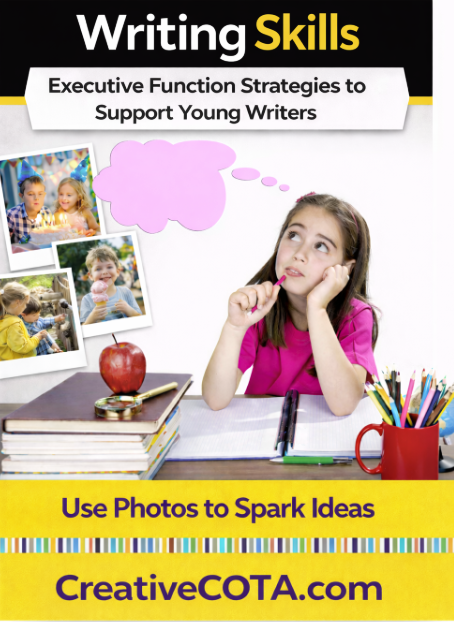
Use Photos to Spark Writing
One strategy I often recommend as an occupational therapy support is encouraging families to take photos of weekend activities or special outings. When students bring these photos to school, they can use them during journal time.
These visual reminders can make a big difference—helping children remember small details like what they ate, who was there, or how they felt. That memory boost often leads to more complete sentences and meaningful writing.
Draw It Out: Turn Talk Into a Writing Plan
Another effective approach is to draw out a student’s thoughts during a conversation. This works especially well for kids who have trouble organizing ideas or visualizing stories.
Try using a simple drawing or story web as a graphic organizer. Stick figures, basic shapes, and quick sketches are all you need—this isn’t about art! For some students, simplifying the visual process helps reduce frustration and allows their ideas to shine. Draw for the student as they tell you things about what happened.
These drawings can go with them back to the classroom. I’ve had many students use these sketches to guide their journal entries or story writing. It gives them a reference point—and a big confidence boost!
One teacher even came rushing down to my room an hour later to tell me that a student had written more using one of these pictures than he had in months. She was so surprised, she had to double-check with the adult in her classroom to make sure he hadn’t received any help.
Support Spelling Without the Pressure
If spelling is also a focus, let your student help sound out the words while you write them down. That way, they’re actively participating in the writing process, but they aren’t overwhelmed by trying to do everything at once.
Where to Find More Visual Writing Prompts
- Picture books – pause before turning the page and ask, “What do you think is happening here?”
- Magazine cutouts – great for collage stories or group prompts
- Flashcards and trading cards – characters, animals, or places can all serve as instant inspiration
- Photos of classroom events – bulletin boards, field trips, or classroom jobs can double as story starters
- Seasonal or holiday clip art – rotate these for calendar-based writing prompts
When you integrate a picture prompt into your writing block, you’re helping students see their story before writing. This often leads to stronger vocabulary, sentence length, and overall engagement.
Add a Game Element with “Roll a Story” Writing Prompts
For students who need a more playful approach, try this simple game that combines writing and chance:
Roll a Story – A Creative Dice Game
- Create three lists:
- Characters (e.g., a dragon, a superhero, a lost puppy)
- Settings (e.g., under the sea, in a classroom, at the park)
- Situations (e.g., finds a treasure, loses a shoe, forgets their name)
- Number each list 1 through 6.
- Roll a die three times:
- First roll = character
- Second roll = setting
- Third roll = what happens
- Let students write or draw a story based on the results.
Bonus: Have students pair up and “retell” their story to a friend before writing. Oral storytelling helps many young writers organize their ideas.
Example:
- Roll 1 = 2 (Superhero)
- Roll 2 = 5 (At the grocery store)
- Roll 3 = 3 (Loses a shoe)
Story Starter: A superhero loses a shoe at the grocery store.
You can keep it simple with paper and dice, or use structured resources to save time.
Looking for a Ready-Made Version?
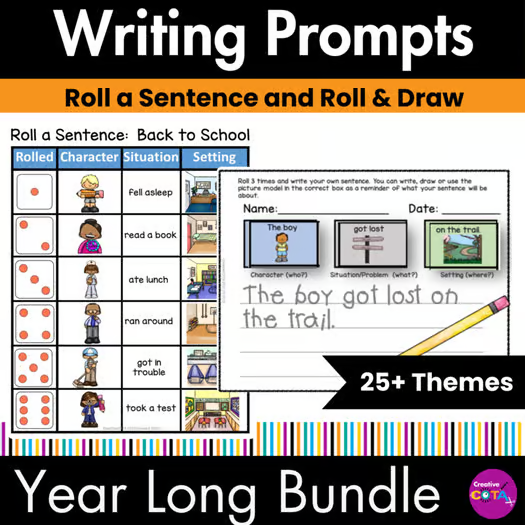
If you want to try this activity without having to prep the pieces yourself, I’ve created sets of Roll-a-Story worksheets on TpT. These ready-to-use pages include dice-based story prompts, drawing space, and writing lines for early elementary students. They’re a quick way to bring structure, fun, and creativity to your writing block—without the planning hassle.
This growing collection of “Roll a Story” writing activities covers a wide range of engaging themes designed to inspire students all year long. Topics include seasonal favorites like Winter, Spring, Summer, and Fall, along with holiday-based prompts for Veteran’s Day, Halloween, Thanksgiving, Christmas, St. Patrick’s Day, and Easter. You’ll also find fun units on Pirates, Transportation, Baseball, Insects, Ocean Animals, and Farm life. Additional sets feature social-emotional learning, community helpers, space, animals, birthday themes, and even idioms and figurative language—making it easy to tie writing practice into nearly any unit or interest area.
Final Tip: Keep your writing prompts fresh by rotating seasonal themes or adding collaborative twists (like group writing or illustration first). For reluctant writers, a picture or a roll of the dice might be the exact nudge they need to get their ideas flowing.

About the Author
I am a Certified Occupational Therapy Assistant (COTA) and have been working in a public school system for more than 25 years. My resources can be found on TPT, BOOM Learning, Made by Teachers, Classful, and Your Therapy Source. I appreciate your interest wherever you wish to shop.
I also now have workbooks on Amazon.
My mission is to help you find creative ideas to incorporate fine motor, visual perception, gross motor, and social-emotional learning into your lessons.
I hope you consider signing up for my Free Resource Library with your Email. I send out emails about once a week and share resources, tips, and planning ideas for your classroom or occupational therapy needs. Hopefully, these help your students work on building their skills in a fun and engaging way.
Thank you for your interest in my resources and ideas. I hope you will consider following my journey on TPT or wherever you wish to shop.