
From recognizing letters and words to copying from the board and solving math problems, visual perceptual skills play a huge role in a child’s academic success. When students struggle with eye tracking, scanning, or visual discrimination, they may find reading, writing, and even simple classroom tasks more challenging.
But the good news? These skills can be developed with the right activities!
What Are Visual Perceptual Skills?
Visual perception refers to the brain’s ability to interpret and make sense of what the eyes see. It’s more than just eyesight—it’s about understanding, organizing, and responding to visual information.
Key areas of visual perception include:
Visual Discrimination – Recognizing differences between similar letters, shapes, or objects (important for reading and spelling)
Eye Tracking & Scanning – Moving the eyes smoothly from left to right, top to bottom, or between lines of text (critical for reading fluency)
Visual-Motor Coordination – Connecting what the eyes see with motor actions, like drawing, cutting, or handwriting
Figure-Ground Perception – Finding important details within a busy background (helpful for copying from the board and staying organized)
Visual Memory – Remembering what was just seen, which helps with spelling, sight words, and problem-solving
How Visual Perception Impacts Learning
Many everyday school tasks depend on strong visual perceptual skills. If a child struggles in this area, they may:
🔹 Lose their place while reading or skip words
🔹 Reverse letters and numbers when writing
🔹 Have difficulty copying from the board
🔹 Struggle with spacing, alignment, and handwriting
🔹 Find math problems confusing due to misreading symbols or numbers
Addressing these challenges early can help students gain confidence and independence in the classroom.
Engaging Activities to Strengthen Visual Perceptual Skills
Building these skills doesn’t have to feel like work! Here are some simple ways to incorporate fun, skill-building exercises into daily routines:
*Spot the Difference Games – Great for visual discrimination, scanning, and attention to detail
*Mazes and Hidden Pictures – Supports eye tracking and problem-solving
*Copying Patterns and Shapes – Helps with visual-motor coordination
*Sorting and Matching Games – Reinforces figure-ground perception I Spy and Find-It Activities – Boosts visual memory and focus
Making Skill Practice Fun and Meaningful
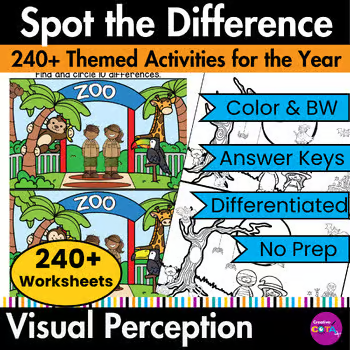
A great way to develop eye tracking, scanning, and visual discrimination is through differentiated spot-the-difference activities. These types of exercises engage students while building critical skills for reading, writing, and comprehension.
Looking for a no-prep ways to target visual perceptual skills? My Spot the Difference resources are differentiated, making it easy to adjust the challenge for different learners. Whether used in occupational therapy, classroom stations, or morning work, these engaging visuals help students strengthen the skills they need for academic success—while having fun!

About the Author
I am a Certified Occupational Therapy Assistant (COTA) and have been working in a public school system for more than 25 years. My resources can be found on TPT, BOOM Learning, Made by Teachers, Classful, and Your Therapy Source. I appreciate your interest wherever you wish to shop.
My mission is to help you find creative ideas to incorporate fine motor, visual perception, gross motor, and social-emotional learning into your lessons.
I hope you consider signing up for my Free Resource Library with your Email. I send out emails about once a week and share resources, tips, and planning ideas for your classroom or occupational therapy needs. Hopefully, these help your students work on building their skills in a fun and engaging way.
Thank you for your interest in my resources and ideas. I hope you will consider following my journey on TPT or wherever you wish to shop.