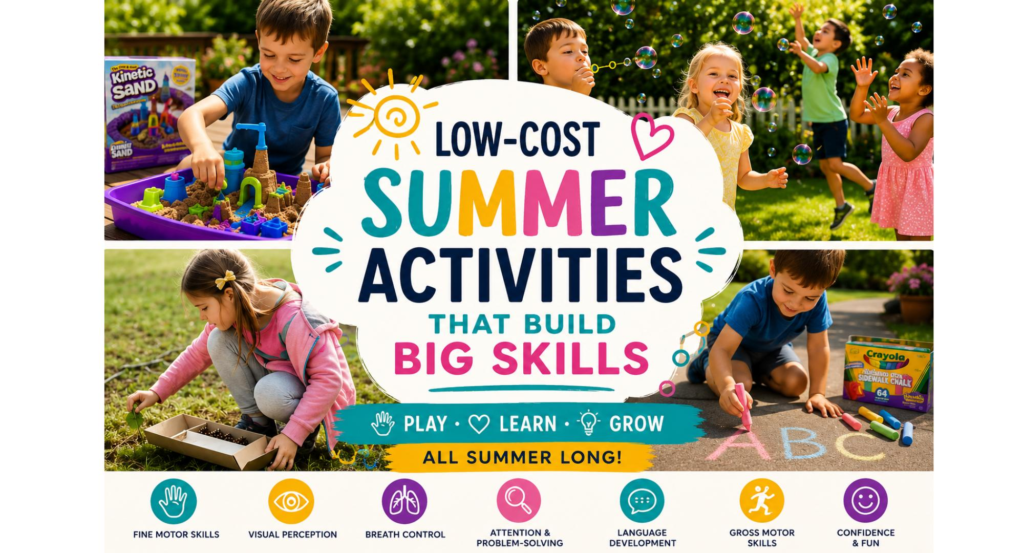
Summer is a wonderful time for children to slow down, explore, and learn through everyday experiences. The good news is that skill-building activities don’t need to be expensive, complicated, or require hours of preparation.
Some of the best activities for developing fine motor skills, visual perception, problem-solving, language, and sensory exploration can be found right in your backyard, neighborhood, or home.
As an occupational therapy practitioner, I often remind parents and teachers that children learn best when they’re having fun. Here are some of my favorite low-cost summer activities that help build important developmental skills while keeping kids active and engaged.
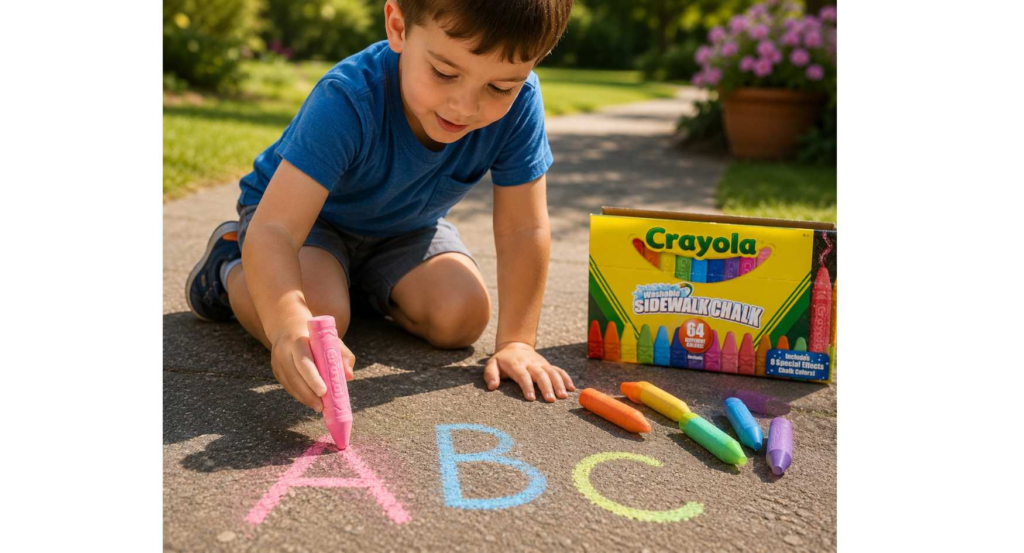
Sidewalk Chalk Adventures
A box of sidewalk chalk can provide hours of entertainment while supporting fine motor development, visual-motor integration, and creativity.
Try:
- Drawing giant roads for toy cars
- Creating hopscotch courses
- Practicing letters, numbers, or sight words
- Making obstacle courses with movement directions
- Playing tic-tac-toe or other simple games
The larger movements involved in chalk activities can be especially helpful for children who find pencil-and-paper tasks challenging. Check out this Crayola sidewalk chalk shaped more like a pig pencil.
Nature Walks
Nature walks provide opportunities for movement, observation, language development, and sensory exploration.
Encourage children to:
- Look for different colors in nature
- Collect leaves, rocks, sticks, or flowers
- Listen for birds and other sounds
- Compare textures
- Describe what they see
These simple activities help develop visual scanning, attention, vocabulary, and critical thinking skills.
Water Play
Water activities are often a summer favorite and require very little setup.
Try:
- Spray bottles
- Watering plants
- Washing outdoor toys
- Filling and pouring containers
- Sponge relay races
These activities strengthen hand muscles while providing sensory experiences and opportunities for problem-solving.
Build, Create, and Explore
Natural materials make excellent building tools. A fun way to create letters for formation and recognition practice.
Children can use:
- Sticks
- Rocks
- Shells
- Pinecones
- Sand
- Dirt
Building structures, creating patterns, and designing imaginary worlds encourages creativity, planning, and fine motor development.
Sand Play and Kinetic Sand
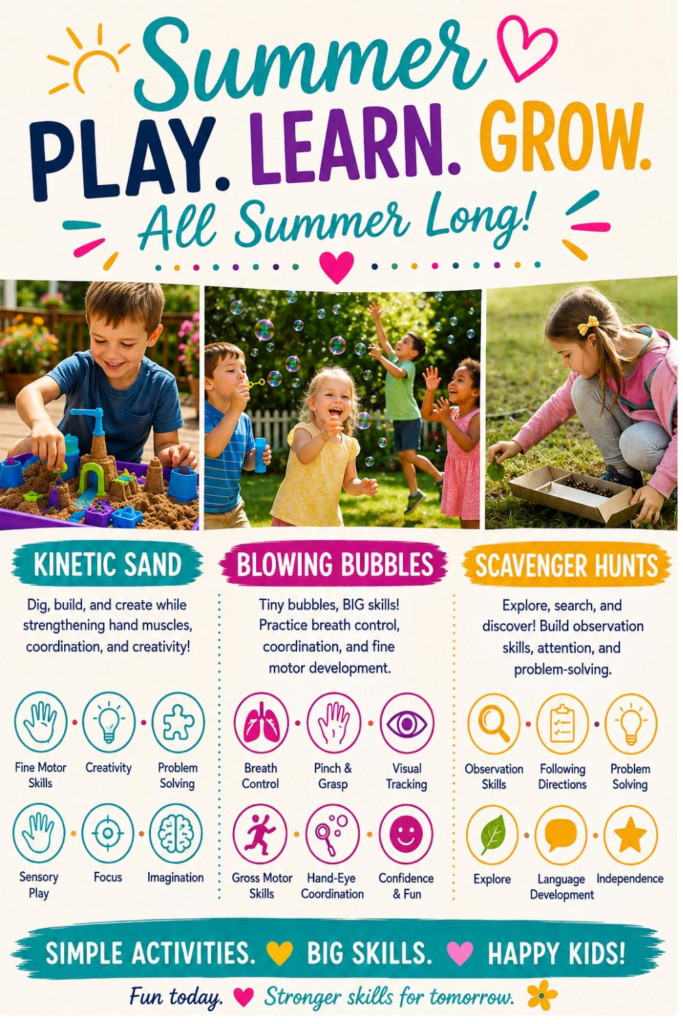
Few summer activities are as timeless as playing in the sand. Whether you’re at the beach, a sandbox, or using a tray of sand at home, digging, scooping, pouring, and building are wonderful ways to strengthen little hands while encouraging creativity and problem-solving.
Children can:
- Dig and bury small objects
- Fill and dump containers
- Build roads, tunnels, and castles
- Draw letters, numbers, and shapes in the sand, use letter stamps and spell out words
- Hide and find treasures
- Create patterns and designs
These activities help develop fine motor strength, bilateral coordination, visual-motor skills, and sensory exploration.
If a trip to the beach isn’t possible, Kinetic Sand is a fantastic alternative. Many children enjoy the unique texture, and it can be used indoors year-round. One of my favorite options is the Kinetic Sand castle-building sets that include molds, tools, and accessories for creating detailed sandcastles and structures.
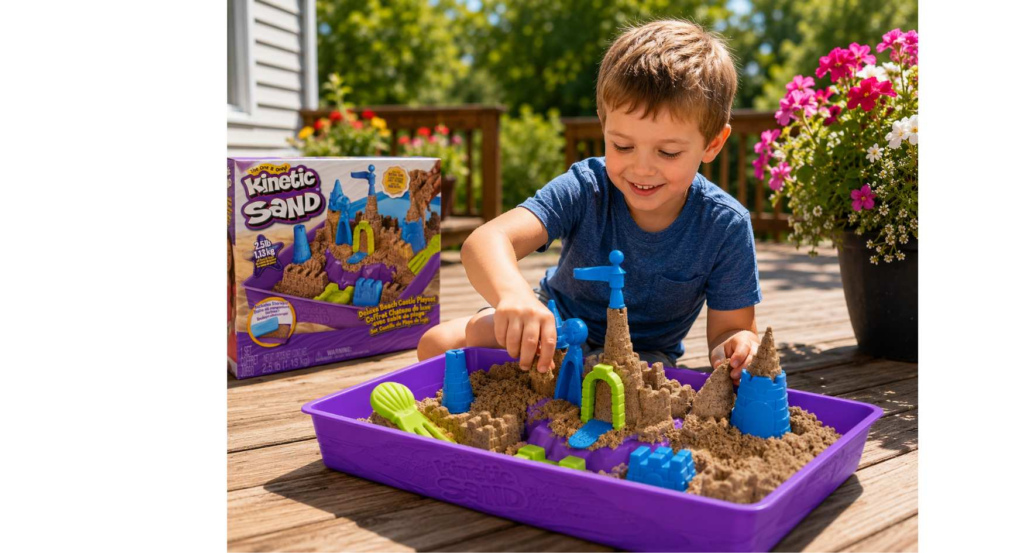
Kinetic Sand can be especially motivating for children who may not enjoy traditional handwriting or fine motor practice. Try hiding magnetic letters or small objects inside, drawing shapes, letters and numbers, or using letter stamps to create words.
Whether children are constructing a giant sandcastle, searching for buried treasures, or simply running their fingers through the sand, they’re building hand strength, coordination, sensory awareness, and creativity while having fun.
Blowing Bubbles

Bubbles are one of my favorite low-cost summer activities because they work on so many skills at once while feeling completely playful. When children blow bubbles, they are practicing breath control and oral motor skills. Learning to take a deep breath and blow slowly enough to create bubbles can help build awareness of the muscles used for breathing, speaking, and mouth control.
The fun doesn’t stop once the bubbles are floating through the air. Encourage children to:
- Pop bubbles using their pointer finger and thumb
- Pinch bubbles between their fingers
- Catch bubbles on a bubble wand
- Reach, jump, and balance while chasing bubbles
- Count how many bubbles they can pop
Pinching bubbles is a great way to strengthen the small muscles of the hand and encourage the development of a tripod grasp needed for coloring, drawing, and writing tasks. Children are often so focused on catching the bubbles that they don’t even realize they are practicing fine motor skills. You can also turn bubble play into a visual tracking activity by encouraging children to watch bubbles move across the sky, follow them with their eyes, or track a specific bubble until it pops.
For just a few dollars, a bottle of bubbles can provide opportunities to work on oral motor skills, visual tracking, hand-eye coordination, grasp development, balance, and motor planning—all while creating plenty of smiles.
Scavenger Hunts: Learning Disguised as Fun
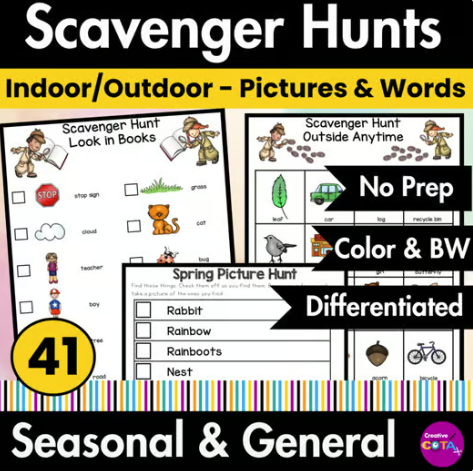
One of my favorite summer activities is a scavenger hunt. Scavenger hunts encourage children to move, observe details, follow directions, solve problems, and interact with their environment. Best of all, they don’t feel like work.
Outdoor scavenger hunts can be used during:
- Nature walks
- Trips to the park
- Summer camps
- Beach days
- Backyard adventures
Children naturally practice observation skills, visual scanning, attention, and language while searching for items around them.
Rainy Day Scavenger Hunts
Summer isn’t always sunny. When the weather keeps everyone indoors, scavenger hunts can still provide a fun and meaningful activity. Household scavenger hunts encourage children to:
- Follow directions
- Search for objects
- Categorize items
- Build vocabulary
- Practice problem-solving
A simple indoor hunt can turn an ordinary afternoon into an adventure while keeping children engaged and moving.
Picture Book Scavenger Hunts
One of my favorite alternatives to traditional worksheets is using scavenger hunts during story time. As children read a picture book, they search for specific items, details, characters, shapes, colors, or objects hidden throughout the illustrations.
This simple activity helps develop:
- Visual perception
- Attention to detail
- Reading comprehension
- Vocabulary
- Observation skills
It’s also a wonderful rainy-day activity that combines literacy and play. Many children who struggle to stay engaged during reading are often more motivated when they have a purpose for looking closely at the pictures.
Why These Activities Matter
The best summer activities often don’t look educational at all.
When children are exploring nature, spraying water, drawing, creating, searching for objects, building with sticks, or examining picture books, they are developing important skills that support future learning.
They are strengthening fine motor skills, visual perception, language, problem-solving, attention, and independence—all while having fun.
And perhaps the best part? Most of these activities cost very little and can be repeated again and again throughout the summer.
Sometimes the simplest activities create the biggest learning opportunities.

About the Author
Hi, I’m Cindy, a school-based Occupational Therapy Assistant with nearly 30 years of experience helping neurodivergent and autistic elementary students succeed in the classroom. Through CreativeCOTA, I share practical therapy ideas, classroom strategies, printables, and resources that save time while making learning more meaningful and engaging.
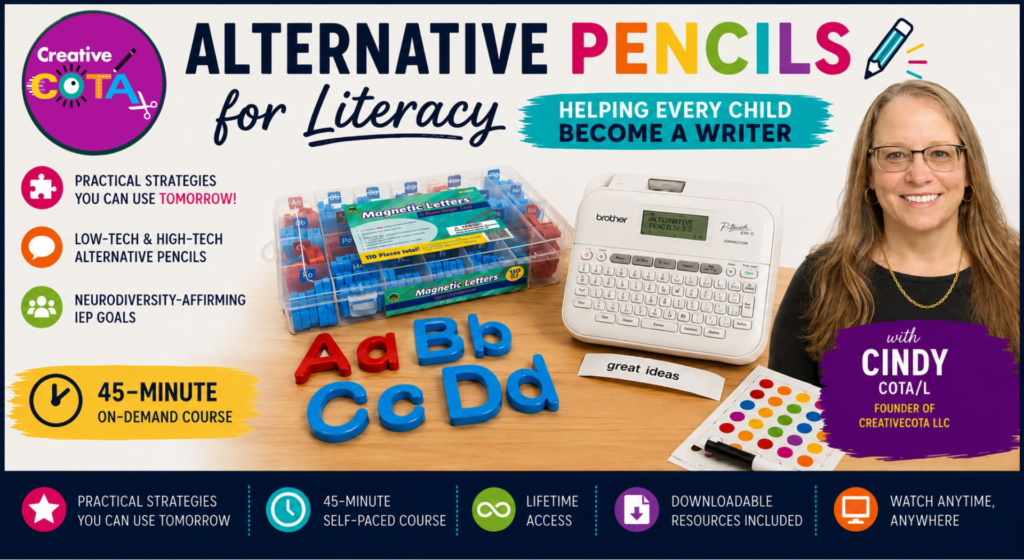
I’m especially passionate about helping struggling writers become successful communicators through the use of alternative pencils. Whether that means using a label maker, magnet letters, address labels, keyboards, or AAC, I believe every child deserves the opportunity to generate text and share their ideas.
When I’m not working with students, you’ll usually find me creating new resources for teachers and therapists, writing on the CreativeCOTA blog, or testing new therapy ideas that make learning feel less like work and more like play.
If you’d like more practical ideas, be sure to explore my blog, browse my Teachers Pay Teachers store, or check out my on-demand course, Alternative Pencils for Literacy: Helping Every Child Become a Writer. I’m so glad you’re here!
This post contains affiliate links. If you use a link and make a purchase, I may receive a small commission at no cost to you.