Sometimes school days just don’t go according to plan.
A substitute arrives and realizes there aren’t quite enough activities to fill the day. Students finish an assignment much faster than expected. The Wi-Fi goes down. Chromebooks aren’t working. The projector refuses to cooperate. Or you suddenly find yourself needing a no print, no technology, no-device activity that can keep students learning without requiring any preparation.
That’s exactly why it helps to have a collection of 25 no prep emergency sub plans and classroom activities ready to go. These activities require little more than supplies already found in an elementary classroom. Most use paper, pencils, crayons, a whiteboard, classroom objects, or dice. No printing, internet, devices, or special materials are needed.
And while I originally thought of these as emergency substitute activities, I quickly realized how useful they are for so many other situations, including my own school-based occupational therapy sessions.
When Can You Use No Prep, No Print Activities?
Keep a few of these ideas in your emergency sub binder or substitute folder, but don’t save them only for a substitute.
They’re also great for no technology days, internet outages, early finishers, indoor recess, morning work, brain breaks, unexpected schedule changes, before or after school breaks, push-in therapy services or a last-minute occupational therapy session plan and those random 15 or 20 minutes that need to be filled.
Most can be completed in about 15–30 minutes and can easily be shortened or extended depending on your students.
Here are 12 of my favorites.
1. Classroom Scavenger Hunt
Turn the classroom into a scavenger hunt without preparing or hiding anything ahead of time.
Ask students to find:
- Something that starts with B
- Something shaped like a rectangle
- Something smaller than their hand
- Something with numbers on it
- Something used for math
- Something they could use to measure
Students can write or draw their answers rather than collecting the objects.
Time: 15–25 minutes
Extend it: Older students can create scavenger hunt clues for a partner.
2. Move & Do Following Directions
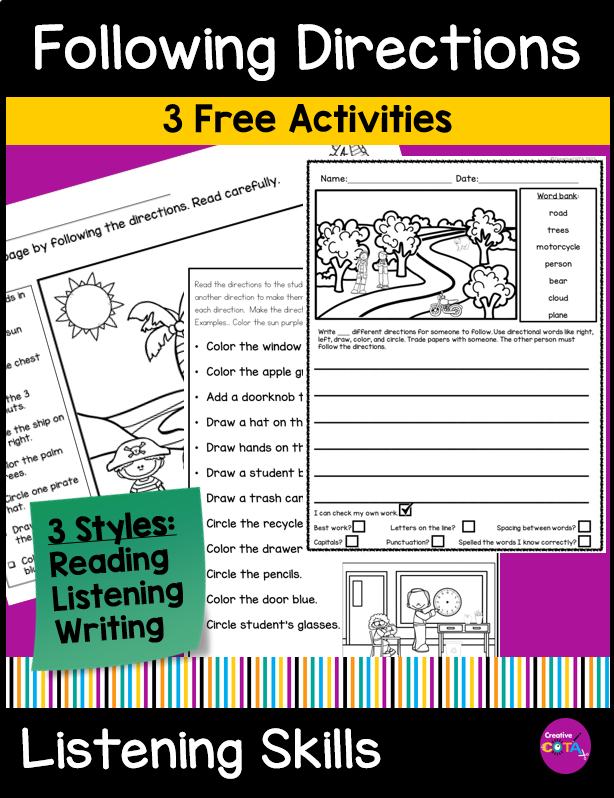
This is an easy way to combine listening, following directions, working memory, and movement.
Start with one-step directions:
“Touch your toes.”
“Clap three times.”
Then increase the difficulty:
“Touch your knees, clap twice, and turn around.”
“March four times, touch your left shoulder, reach up high, and freeze.”
Time: 10–20 minutes
Extend it: Give several directions before allowing students to begin moving.
3. Listen & Draw
Give each student a blank piece of paper and pencil and describe a picture one step at a time.
For a house, you might say:
“Draw a large square in the middle of your paper.”
“Draw a triangle on top for the roof.”
“Add two square windows.”
“Draw a tree to the left of the house.”
“Put a sun in the top right corner.”
Continue adding details and positional directions.
At the end, compare the pictures. Even though everyone heard the same directions, the finished drawings usually look very different!
Time: 20–30 minutes
Extend it: Have students create a picture and write directions for a partner to follow.
4. Mystery Classroom Object
Secretly choose an object students can see in the classroom.
Students ask yes/no questions to figure out what it is:
“Is it bigger than a book?”
“Is it made of plastic?”
“Do students use it?”
“Can you write with it?”
Encourage students to ask questions that eliminate several possibilities rather than immediately guessing objects.
Time: 15–20 minutes
Extend it: Students choose their own mystery objects and create clues for classmates.
5. Snowball Trash Ball Word Wall
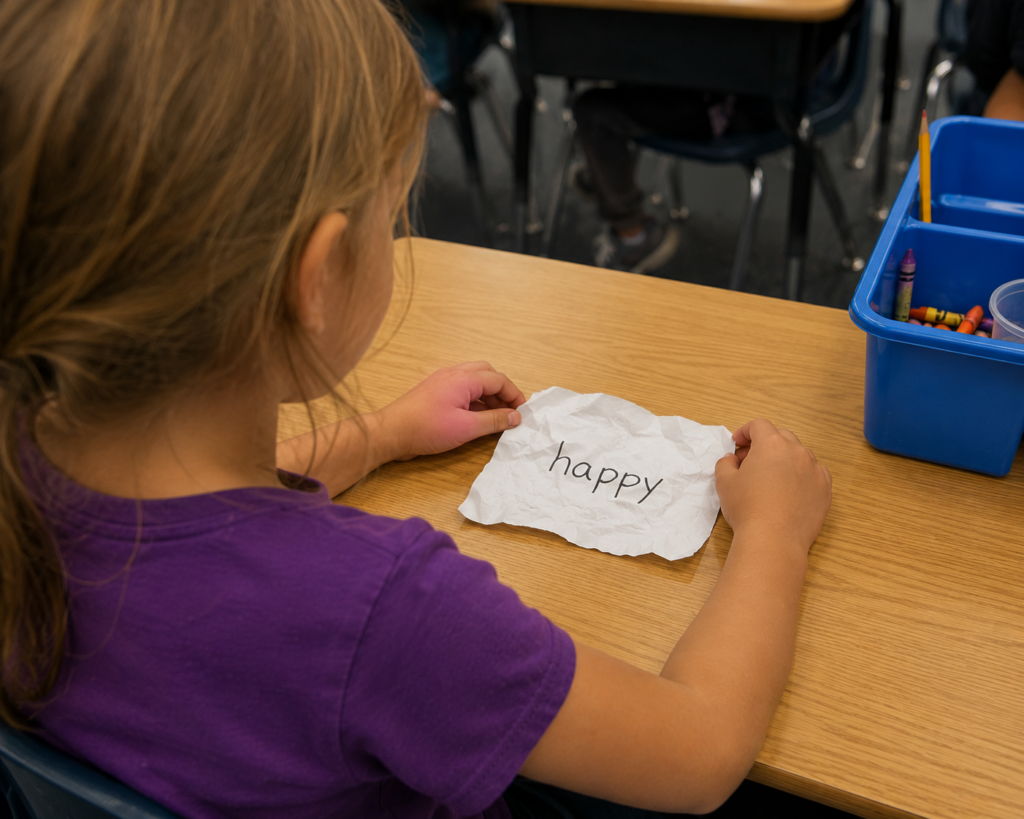
This one combines literacy and movement.
Give each student a sight word, spelling word, vocabulary word, or word-wall word on a piece of scrap paper.
Students read or write their word, crumple the paper into a “snowball,” and gently toss it into an open area of the classroom.
Everyone finds a different snowball and opens it.
For each round, students can:
- Read the word
- Write the word
- Spell it
- Use it in a sentence
- Count the letters
- Write a sentence using the word
Crumple, toss, find a new word, and repeat.
Time: 20–30 minutes
Extend it: Older students can use science, social studies, math, or other content-area vocabulary.
6. What Changed? Classroom Detective
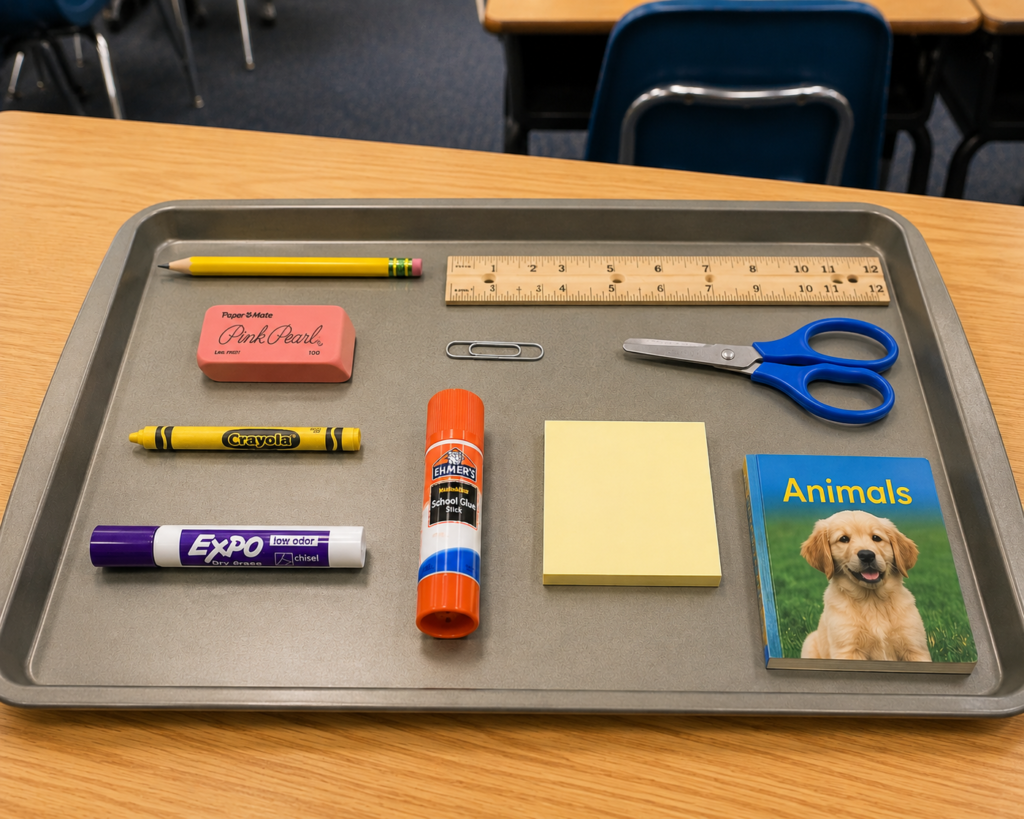
Give students about 30 seconds to carefully study an area of the classroom or a tray of objects.
Have them close their eyes while you make one small change.
Move a pencil. Turn a book around. Remove a marker. Switch two objects.
Students open their eyes and try to identify what changed.
Time: 15–25 minutes
Extend it: Make two, three, or even five changes at once.
This is a simple way to work on visual attention, observation, and memory using materials already in the room.
7. Fortunately, Unfortunately Class Story
Start a class story with something unexpected:
“One morning, our class discovered a tiny dragon under the teacher’s desk.”
The first student continues:
“Fortunately, the dragon was friendly.”
The next adds:
“Unfortunately, it ate all of our pencils.”
Continue around the room, alternating between fortunately and unfortunately.
Time: 20–30 minutes
Extend it: Have students write and illustrate their own Fortunately/Unfortunately stories.
8. Number Hunt Around the Room
Numbers are everywhere in an elementary classroom.
Have students search calendars, clocks, books, rulers, posters, number lines, charts, and classroom labels.
Challenge them to find:
- An even number
- An odd number
- A two-digit number
- A number greater than 50
- A multiple of 5
- Two numbers they can add together
- The largest number they can find
Time: 20–30 minutes
Extend it: Older students can search for factors, multiples, prime numbers, fractions, or numbers they can combine to create equations.
9. Roll & Solve Math
Grab a couple of dice from the classroom. If you don’t have dice, write the numbers 1–6 on scraps of paper.
Students can:
- Roll two dice and add
- Roll and subtract
- Roll and multiply
- Create the largest two-digit number possible
- Create the smallest two-digit number possible
- Compare numbers using >, <, or =
- Roll three times and create a three-digit number
Time: 20–30 minutes
Extend it: Older students can roll three or four dice and use every number to create an equation.
10. Which One Doesn’t Belong?
Write four numbers, shapes, words, or objects on the board and ask:
Which one doesn’t belong?
For example:
2 4 7 8
Seven might not belong because it’s odd.
Two might not belong because it’s the only number less than four.
Eight might not belong because it’s the largest.
The best part is that there can be more than one correct answer as long as students can explain their reasoning.
Time: 15–25 minutes
Extend it: Have students create their own sets and challenge classmates to find multiple answers.
11. Create a Classroom Graph
Collect real data from the students with a quick classroom survey.
Ask something like:
What is your favorite season?
Winter | Spring | Summer | Fall
Record responses with tally marks and turn the results into a simple graph.
Then ask:
- Which choice received the most votes?
- Which received the fewest?
- How many students voted altogether?
- How many more chose one answer than another?
- Did any categories receive the same number of votes?
Time: 25–40 minutes
Extend it: Older students can represent the results using fractions, ratios, percentages, or different types of graphs.
12. Movement This or That
Give students two choices and assign a movement to each answer.
For example:
Dogs or cats?
Dogs = march in place
Cats = stretch up high and touch your toes
Beach or mountains?
Beach = pretend to swim
Mountains = march with high knees
Dinosaurs or dragons?
Dinosaurs = five slow stomps
Dragons = stretch your arms out and flap your wings five times
Time: 10–20 minutes
Use just a few questions for a quick brain break or continue playing when you have more time to fill.
Extend it: Let students create their own This or That questions and assign safe movements to each choice.
Using These Activities in Occupational Therapy
While these activities work well for classroom teachers and substitutes, many also fit naturally into school-based occupational therapy.
As an OT, I especially like having something like this printed and tucked into my emergency therapy plans. The activities are easy to adapt for fine motor, visual perceptual, listening, following directions, movement, motor planning, and executive functioning skills.
They’re especially handy when my therapy schedule changes, I end up with an unexpected group, technology isn’t available, or I simply need a quick activity to fill the rest of a session.
Listen & Draw can become a visual-motor and following-directions activity. Classroom Detective works on visual attention and memory. Movement activities can incorporate bilateral coordination, crossing midline, body awareness, and motor planning. Literacy and math activities can easily include handwriting or alternative ways to generate text.
The activity stays simple while you decide which skills you want to target.
What If the Technology Isn’t Working?
This might be one of my favorite reasons to keep activities like these nearby.
Even carefully planned digital lessons aren’t much help when the Wi-Fi goes down, devices aren’t charged, the projector isn’t working, or technology simply isn’t an option that day.
These activities are intentionally screen-free.
Most require nothing more than:
Paper • Pencils • Crayons • Dice • Classroom Objects • Word Walls • Whiteboard
Everything you need is probably already somewhere in the classroom.
Want More No Prep, No Print Activity Ideas?
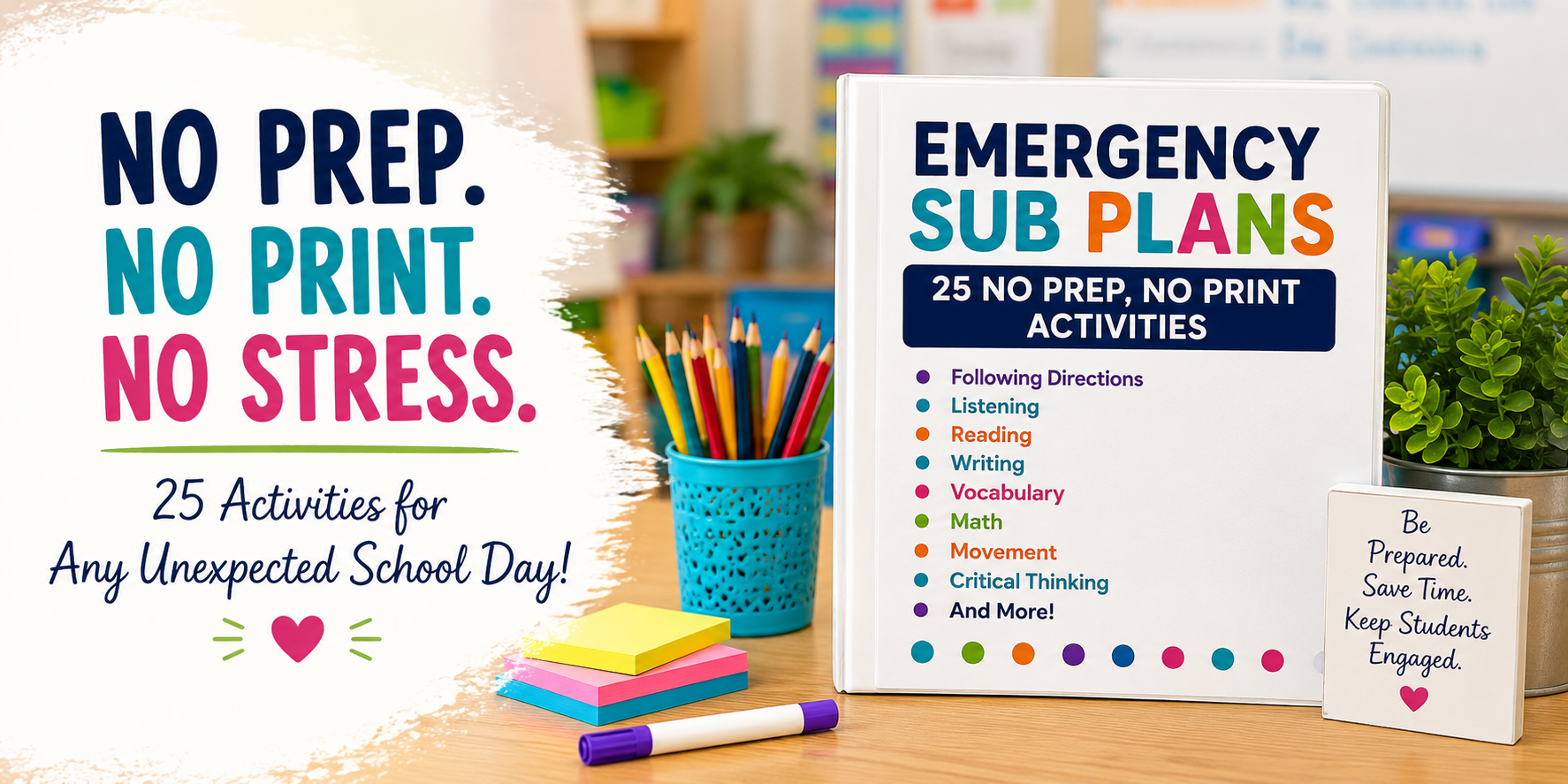
These are just 12 of the 25 activities included in my new No Prep, No Print Emergency Sub Plans Activities resource.
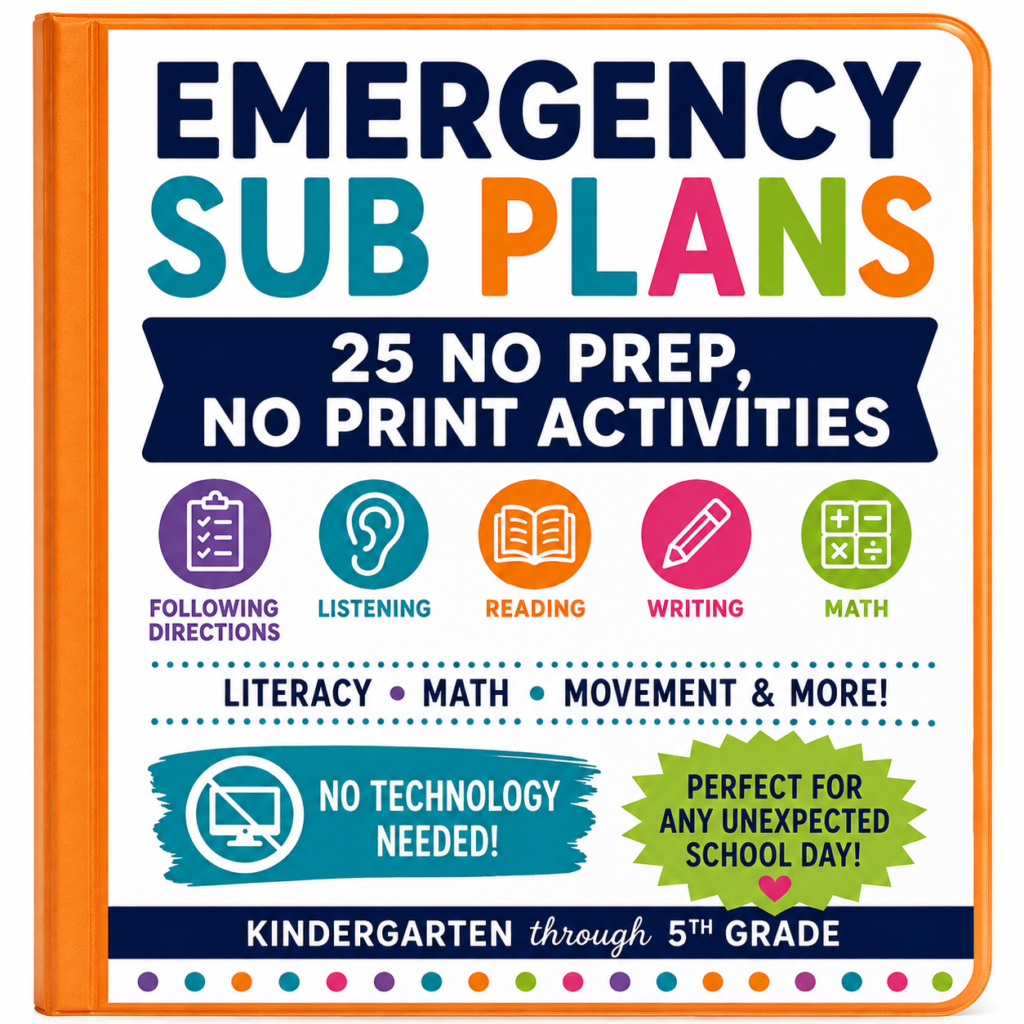
The complete resource includes a much wider variety of literacy, math, following directions, listening, movement, visual attention, problem solving, and critical thinking activities.
More importantly, you don’t have to remember how to do any of them when you need them.
Each of the 25 activities includes specific directions, ready-to-use examples, approximate times, and extension and challenge ideas. Most take about 15–30 minutes, with several that can be extended to 30–45 minutes.
Altogether, you’ll have 10+ hours of flexible activity ideas for Kindergarten through 5th grade, with extensions that can also work with older students.
Print the pages once and tuck them into your emergency sub binder or therapy plans. Then they’re ready for an unexpected absence, schedule change, technology outage, early finishers, indoor recess, or one of those school days when you suddenly realize you have 20 minutes left and nothing planned.
About the Author
Hi, I’m Cindy, a school-based Certified Occupational Therapy Assistant with nearly 30 years of experience helping children build the skills they need for success at school and beyond. At CreativeCOTA, I share practical therapy ideas, classroom activities, fine motor resources, and simple strategies that help children learn through meaningful play. Whether you’re a teacher, therapist, homeschool parent, or caregiver, I hope you’ll find ideas that save time and make learning fun.