“What did you do over the weekend?”
It sounds like such an easy question. As adults, we can probably come up with an answer pretty quickly. If you asked me this weekend, I could tell you that I worked on a few updates for CreativeCOTA, visited my father-in-law, and watched some football.
But ask some students that same question and you may get:
“I don’t know.”
Or a blank piece of paper.
Or a student who spends ten minutes trying to decide what to write about and never actually gets started.
Sometimes we look at that blank paper and think the student is struggling with writing. But the actual difficulty may have started long before the pencil ever touched the paper.
Writing Requires A LOT of Executive Function Skills
Think about everything a student has to do when we say, “Write about what you did this weekend.”
Before writing a single word, the student needs to:
- Recall events from the weekend
- Decide which event to write about
- Figure out what happened first, next, and last
- Decide which details are important
- Organize those thoughts into a sentence or story
- Find the words they want to use
- Remember their idea long enough to get it down
Then, if we require pencil-and-paper writing, we add another whole layer. Now the student may also need to think about letter formation, spelling, spacing, punctuation, capitalization, staying on the line, and physically controlling the pencil.That simple writing assignment suddenly isn’t so simple! For students who struggle with executive function, working memory, language, attention, or motor skills, an open-ended writing assignment can require a tremendous amount of cognitive work.
“I Don’t Know” Doesn’t Always Mean They Don’t Have an Idea
One thing I try to keep in mind as an occupational therapy assistant is that a student staring at a blank page may have plenty to say.They just might not know how to get started. Instead of immediately focusing on handwriting, it can help to back up and separate coming up with the message from physically writing the message. What does the student actually want to tell us?
That is where prompts, conversation, and drawing can be incredibly helpful.
Start With Conversation Instead of the Pencil
Before asking a student to write about the weekend, talk about it.
You might ask:
“What was one fun thing you did?”
“Did you stay home or go somewhere?”
“Who were you with?”
“Did you play a game?”
“Did you watch something?”
“Did you eat anything you really liked?”
“Did anything funny happen?”
Specific questions can be much easier to answer than one big, open-ended question.
You can also give choices.
Did you play outside, watch TV, play a game, visit someone, go somewhere, or do something else?
Once the student has an idea, you have taken care of one of the biggest hurdles: deciding what to write about.
Let Them Draw It First
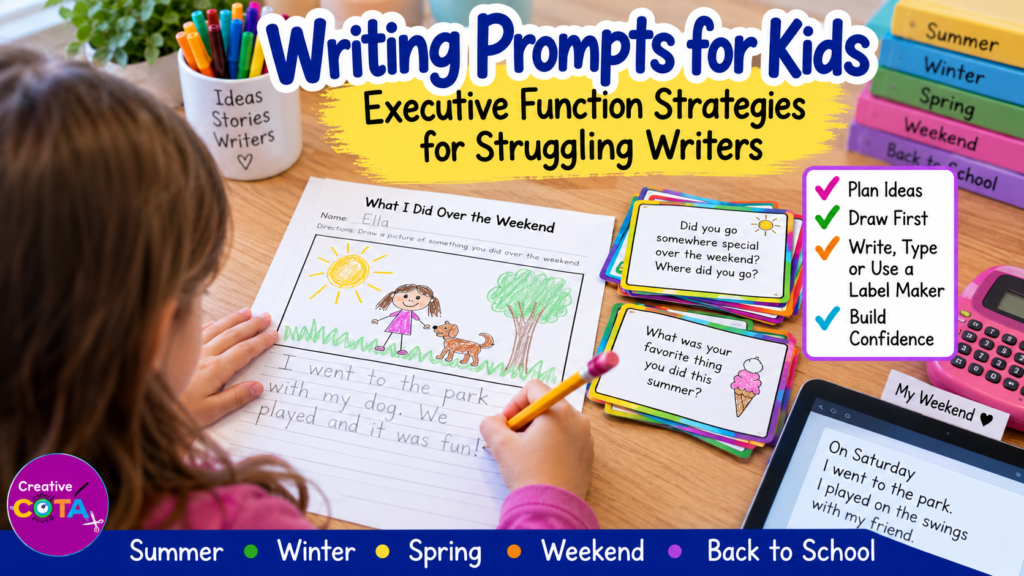
Drawing before writing isn’t wasting time. For many students, the picture can become their planning tool.
If a child draws themselves playing soccer with their brother, suddenly you have something concrete to talk about.
“Who is that?”
“Where were you?”
“What happened?”
“Who kicked the ball?”
“Was it fun?”
Now you aren’t asking the student to create a story out of thin air. You’re helping them pull language and details from something they can see. The drawing can also help with working memory. Instead of trying to hold the entire idea in their head while worrying about spelling and handwriting, the student has a visual reminder right in front of them.
Use the Picture to Build the Story
Once the student has drawn the idea, you can help them turn it into a sentence.
A student might start with:
I played soccer.
Then you can build from there:
I played soccer with my brother.
Or:
On Saturday, I played soccer with my brother in our backyard.
The goal doesn’t always have to be a long story.
For one student, independently generating one meaningful sentence may be a much bigger accomplishment than copying an entire paragraph someone else created for them.
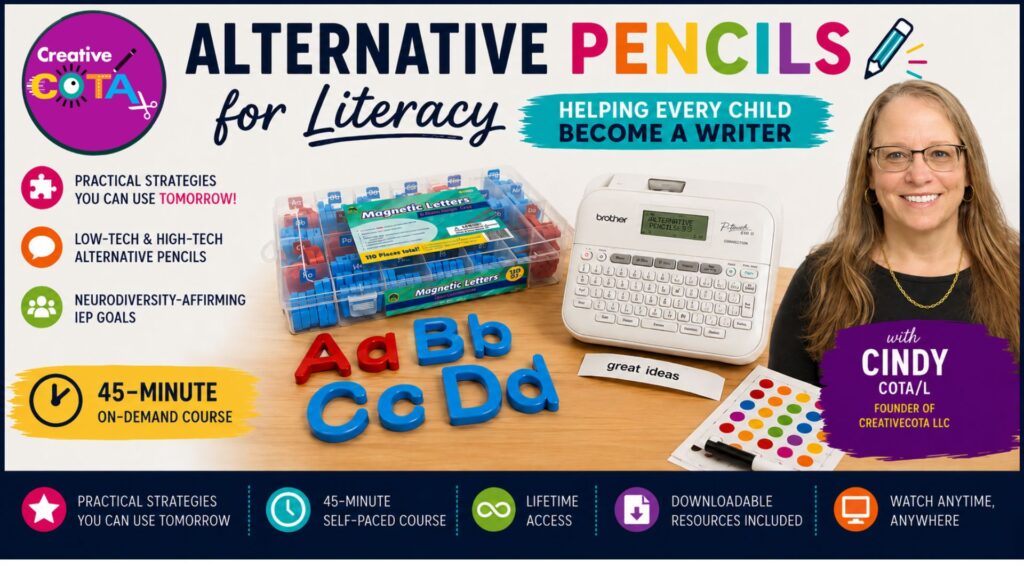
And remember, writing does not have to mean pencil and paper. If the goal is for a student to generate and organize their own ideas, give them different ways to get those ideas down. A student might type their sentence on a Chromebook or iPad, use a label maker to create the words or sentences, or use voice-to-text to tell their story.
The important question is: What is the goal of the activity? If you’re working specifically on handwriting, then yes, picking up the pencil may be part of the goal. But if you’re working on storytelling, sequencing, sentence generation, or organizing ideas, handwriting difficulties don’t necessarily need to stand between the student and the story they want to tell.
Writing Prompts Can Reduce the Planning Load
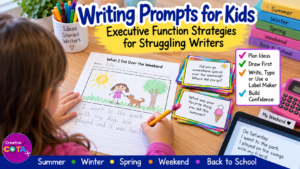
This is also why I like using writing prompt cards. A prompt gives students a starting point.
Instead of:
“Write something about your summer.”
Try:
“What was your favorite thing you did outside this summer?”
Or instead of:
“Write about winter break.”
A student might respond to a more specific question about someone they visited, a favorite meal, something they played, or a place they went. The prompt doesn’t do the thinking for the student. It simply narrows down the enormous number of possibilities. For students who have difficulty with initiation and planning, that little bit of structure can make a big difference.
Give Students Different Ways to Tell Their Stories
Once students know what they want to say, think about how they can get that message out.
Depending on the student and your goal for the activity, they might:
- Write with a pencil, marker, or other writing tool
- Type on a Chromebook, computer, or iPad
- Use a label maker to create words and sentences
- Use voice-to-text to dictate their story
- Use an AAC device
- Use magnetic letters or another alternative pencil
- Tell the story to an adult who scribes it
- Draw the story and add words or labels
- Combine several of these methods
This is especially important for students who have wonderful ideas but find handwriting physically or cognitively demanding. Sometimes when we take away some of the motor demands, we get to see what a student actually knows.
A child who struggles to handwrite one sentence may be able to generate several sentences when typing or using voice-to-text. That’s useful information! We can still address handwriting as its own skill while also giving the student opportunities to be an author.
Weekend Writing Is Perfect for Practicing These Skills
One of the easiest ways to make this part of your routine is the classic Monday morning question:
“What did you do over the weekend?”
You can use the same basic process each week:
Talk → Choose an idea → Draw → Add details → Tell the story
Then let the student use the method that fits the goal: write it, type it, make it with a label maker, use voice-to-text, or use another alternative pencil. Because the routine stays familiar, students can spend less energy figuring out what they are supposed to do and more energy generating their message.
And don’t worry if a student tells you they “did nothing.” Most of us don’t have exciting adventures every weekend!
Talk about a show they watched, a game they played, something they ate, sleeping late, playing with a pet, visiting Grandma, going grocery shopping, or just hanging out at home. Everyday experiences are still worth telling stories about.
Use the Same Strategy After School Breaks
This approach works well beyond Monday morning writing. After summer vacation, winter break, spring break, or another school vacation, students often return to the classroom and are immediately asked to write about what they did. That can be especially difficult after being away from the classroom routine.
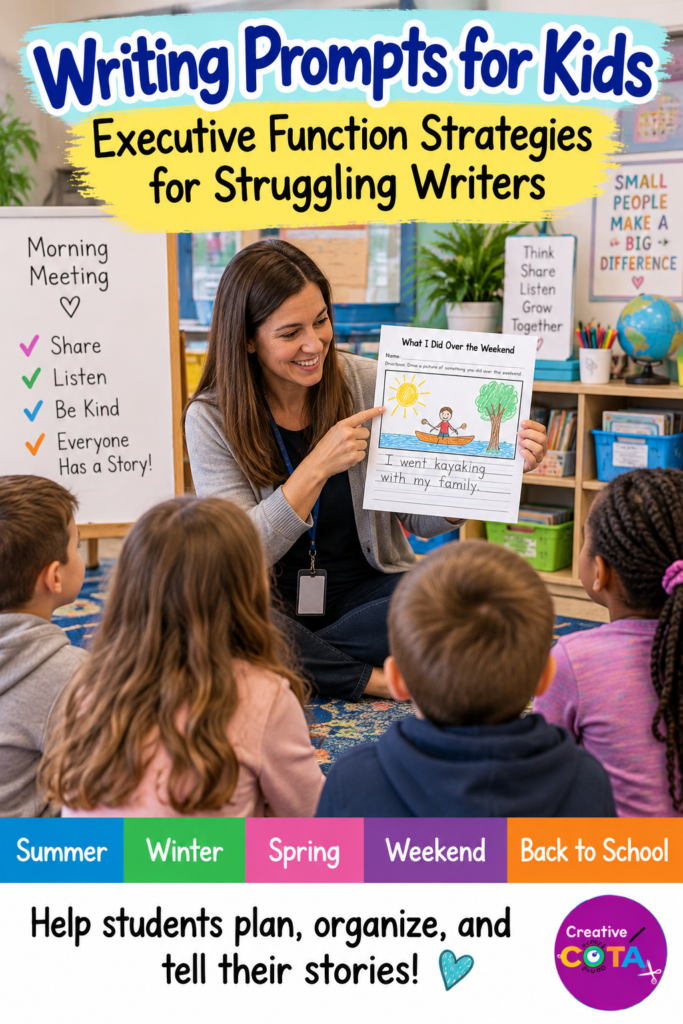
Try giving students time to talk, look at specific prompts, draw, and organize their thoughts before expecting a finished response. You can also use the discussion as a classroom community activity. Students can practice listening to one another, taking turns, asking questions, recalling events, and telling a story in sequence.
Now your writing activity is supporting expressive language, receptive language, social communication, sequencing, vocabulary, and executive function skills too.
The Writing Prompts I Use
I created my What I Did Writing Prompts originally for my special education occupational therapy students because I wanted an easy way to help students get their ideas flowing before we focused on getting those ideas down.
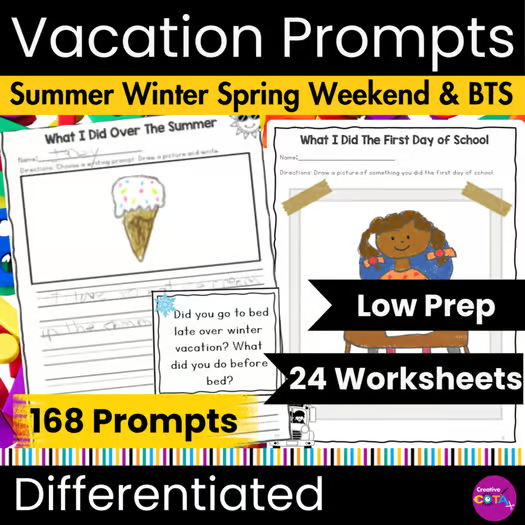
The resource includes 168 kid-friendly prompt cards and 24 printable worksheets covering seven topics:
- What I Did Over the Summer
- First Day of School
- First Week of School
- What I Did Over School Vacation
- What I Did Over the Weekend
- What I Did Over Winter Vacation
- What I Did Over Spring Break
There are also three differentiated writing page styles, including a picture-only option, a picture with larger writing lines for shorter responses, and a picture with space for students who are ready to write more.
But students don’t have to use the included writing pages. The prompt cards can just as easily be paired with a Chromebook, iPad, label maker, voice-to-text, AAC, alternative pencils, or whatever method allows the student to generate their message.
I like having that flexibility because students in the same classroom or small group may be working at very different levels and may need very different tools.
The prompt cards can also be printed, cut, and laminated so you can pull them out again throughout the year.
You can check out the complete What I Did Writing Prompts resource here.
One teacher who used the resource shared:
“Thank you very much for this assignment. I love how there was differentiation that I could use with in small groups. Thank you!”
— Cassandra D.
Sometimes the Best Writing Support Happens Before Writing Begins
When a student struggles with writing, it is easy to focus on the finished paper.
Are the letters formed correctly?
Did they use spaces?
Did they write enough?
But sometimes we need to look at everything that happened before the writing.
Could the student think of an idea?
Could they choose one idea from several possibilities?
Could they organize it?
Could they remember it?
Could they find the words to explain it?
Could they get started?
And finally, are we giving them a way to get their message out that works for them?
A writing prompt, a quick conversation, and a few minutes to draw may seem like very simple supports, but they can reduce some of the executive function demands that make an open-ended writing assignment feel overwhelming.
Then we can give students options for generating their text, whether that’s a pencil, keyboard, label maker, voice-to-text, AAC, or another alternative pencil.
Because sometimes the biggest accomplishment isn’t perfect handwriting.
It’s helping a student discover that they have a story to tell and giving them a way to tell it.