
Following directions is one of those skills we expect students to use all day long.
Get your pencil. Write your name. Turn to page 12. Circle the answer. Put your paper in the basket. Line up at the door.
For some students, that is a LOT to process.
Following directions requires more than simply listening. Students may need to attend to the speaker, understand the words being used, remember the information, figure out the correct order, tune out distractions, and then actually complete the task.
That means we can practice following directions without always reaching for another worksheet.
Here are 15 following directions activities for elementary students that can be used in the classroom, during occupational therapy or speech therapy, in special education, or even for a quick movement break.
1. Draw What I Say
Give students a blank piece of paper or white board and provide simple drawing directions.
Try directions such as:
- Draw a large circle in the middle of your paper.
- Draw a small square inside the circle.
- Put a star above the circle.
- Draw three lines underneath it.
Start with one-step directions and gradually increase to two- and three-step directions.
This is an easy way to work on listening, spatial concepts, working memory, and visual-motor skills at the same time.
2. Add Movement to the Directions
Following directions does not have to mean sitting at a desk!
Try:
- Touch your toes and then clap three times.
- Jump two times and touch something blue.
- Walk to the door, turn around, and give me a thumbs-up.
Movement can be especially helpful when students are having difficulty attending during seated activities.
3. Play Simon Says
There is a reason this game has been around forever.
Simon Says requires students to listen carefully before acting rather than simply copying what everyone else is doing.
Make it more challenging by adding concepts you are already working on:
“Simon says put your hands under the table.”
“Simon says touch your left knee.”
“Simon says clap four times and then stomp twice.”
4. Build an Obstacle Course
You don’t need a fancy therapy gym to make a following directions obstacle course.
Use whatever you have available and give directions such as:
“Walk around the chair, step over the tape, and crawl under the table.”
For younger students, demonstrate the course first. As students become more successful, see whether they can complete it from verbal directions alone.
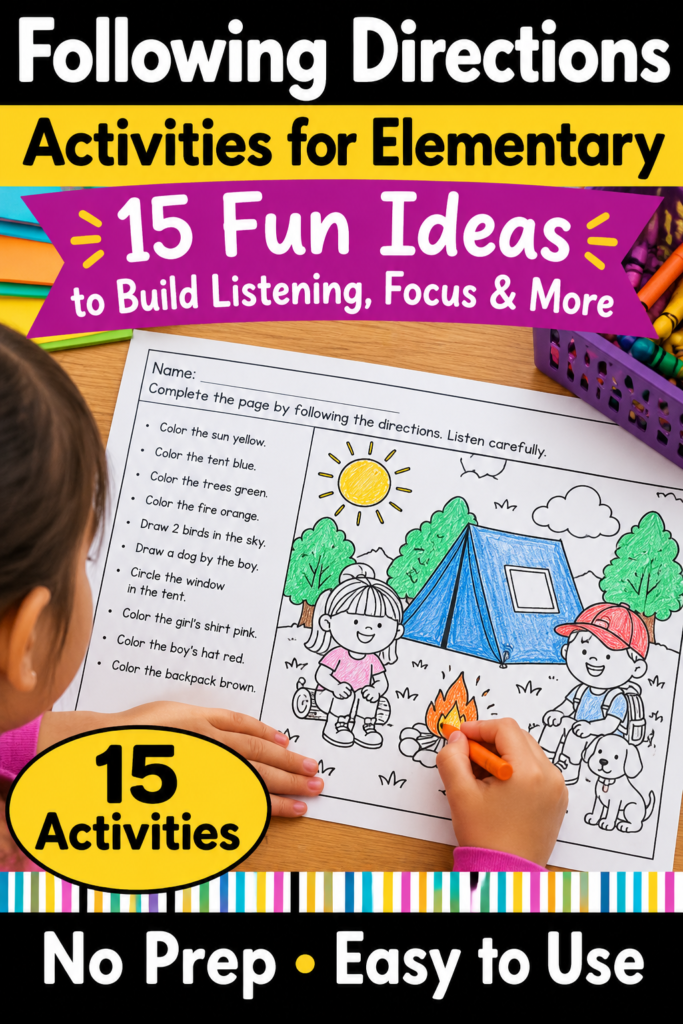
5. Color by Verbal Directions
Give everyone the same simple picture, but don’t give them written coloring directions.
Instead, tell students what to do:
“Color the hat red.”
“Color the door blue and put a yellow sun in the sky.”
You can easily adjust the difficulty by changing the number of steps or the complexity of the language.
Want the pictures and directions already made?
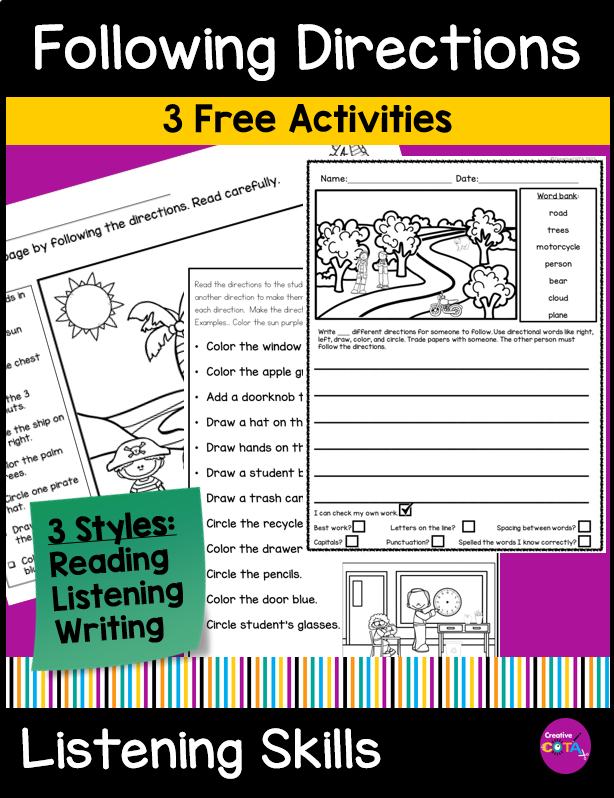
My Following Directions Coloring and Drawing Activities were created for exactly this type of practice. Students listen to directions and color or add details to a picture while working on listening, fine motor, visual-motor, and language skills.
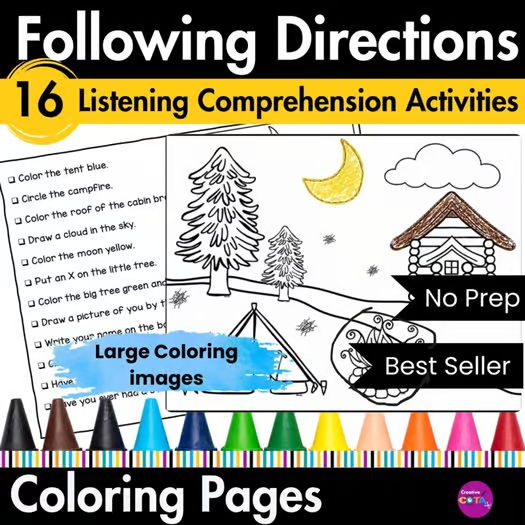
I use activities like these because I can make them easier or harder depending on the student. I can give one direction at a time, combine several directions, or even add movement between steps.
6. Have a Classroom Scavenger Hunt
Give students directions that send them around the classroom.
“Find something that is round.”
“Find something red and bring it back to the table.”
“Find a book, touch the classroom door, and then sit on the rug.”
You can also have students work with a partner and give directions to each other.
7. Build It
Grab blocks, LEGO bricks, magnetic tiles, cubes, or whatever building materials you already have.
Give students directions such as:
“Put the blue block on top of the red block.”
“Put two yellow blocks beside the green block.”
Older students can listen to several directions before they begin building.
This is a great way to incorporate positional words such as above, below, beside, between, behind, and in front of.
8. Follow Directions During a Craft
Crafts naturally involve sequencing and following directions.
Instead of completing each step for students, break the project into manageable directions.
“Cut out the circle and glue it at the top of your paper.”
You can also give students a visual model while providing verbal directions. They do not have to rely on listening alone for this to be valuable practice.
9. Play Copy Me
Create a short movement sequence:
Clap, stomp, clap.
Students watch and copy.
Then try giving the sequence verbally without demonstrating it.
“Clap twice, stomp once, and put your hands on your head.”
This is a quick activity when you have only a few minutes between lessons or therapy activities.
10. Use Silly Directions
Sometimes the best way to get students listening is to make the directions unexpected. If you can hear me…
“Put your pencil on your head.”
“Touch your nose and say banana.”
“Stand up, turn around, and pretend you are a chicken.”
Silly directions can make practicing listening feel much less like work.
And students usually let you know immediately if YOU forget one of the steps!
11. Make a Mystery Picture
Give each student a blank paper and describe what to draw without telling them what the final picture will be.
For example:
“Draw a large circle.”
“Add two triangles to the top.”
“Draw two small circles inside the large circle.”
“Add six lines coming out from the sides.”
Eventually they realize they are drawing a cat.
This is a fun way to practice listening while also working on spatial concepts and visual-motor skills.
12. Use Everyday Classroom Routines
You don’t always need a special activity.
Everyday routines provide plenty of opportunities to practice following directions.
Instead of:
“Clean up.”
Try:
“Put your crayons in the box and your paper in the basket.”
Once students are successful, you can add another step.
These natural opportunities are often more meaningful than practicing the skill in isolation.
13. Let Students Give the Directions
This one is important.
Students shouldn’t always be the ones following directions.
Let them be the teacher!
A student can tell a partner how to build something, draw a picture, complete an obstacle course, or find an object.
Generating clear directions requires students to think about sequencing, vocabulary, perspective, and communication in a completely different way.
14. Try a Listen and Draw Activity
Give students part of a picture and have them add details based on oral directions.
For example:
“Draw a bird on the roof.”
“Put three flowers beside the house.”
“Draw a cloud above the tree.”
This is one of my favorite ways to work on listening because there is an immediate visual result. You can quickly see whether the student understood the direction.
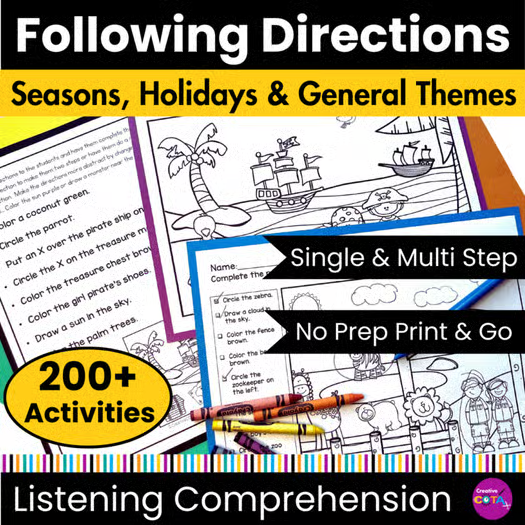
My Listen and Draw Following Directions Activities use this same idea with ready-to-use pictures and directions.
15. Combine Following Directions With Writing
For older elementary students, take the activity one step further.
After completing a listening or drawing activity, have students:
- Write the directions for someone else.
- Describe what they did.
- Put the steps in order.
- Write a sentence about the finished picture.
- Create their own directions for a partner.
And remember that writing doesn’t always have to mean handwriting.
Students can type, use a label maker, choose words or letters, use AAC, use voice-to-text, or use another alternative pencil to generate their response.
The goal is communicating the message, not making every activity a handwriting task.
How to Make Following Directions Easier or Harder
One of the things I like about these activities is how easily they can be adapted.
For students who need more support, use shorter directions, visual supports, gestures, repetition, familiar vocabulary, or one step at a time.
For students who are ready for more of a challenge, increase the number of steps, add positional concepts, delay the response, include irrelevant information, or have students repeat the directions before beginning.
You can also change how the directions are presented.
Try giving them:
- Verbally
- In writing
- With pictures
- With gestures
- Through AAC
- With a combination of supports
A student who struggles with verbal directions may do much better when information is presented visually. That tells us something important about how we can support that student throughout the school day.
Following Directions Is More Than Listening
When a student doesn’t follow a direction, it is easy to assume they weren’t listening.
But there can be much more going on.
The student may not have understood the vocabulary. They may have forgotten part of the direction. There may have been too many steps. They may have been distracted by something happening in the room. They may need additional processing time or a visual support.
Instead of simply repeating, “Listen!” Try changing the way the information is presented. And whenever possible, practice following directions through movement, play, drawing, building, creating, and activities students actually want to do.
I’ve always found that students get more accomplished when it doesn’t smell like work.
Looking for Ready-to-Use Following Directions Activities?
I have a growing collection of following directions, listening, coloring, drawing, and movement activities in my CreativeCOTA store. I originally created many of them for my own occupational therapy students, but they can also be used in elementary classrooms, special education, speech therapy, centers, morning work, small groups, or with a substitute.
You can use them as written or adjust the directions to meet the needs of the students in front of you.
Happy listening and learning!

About the Author
I am a Certified Occupational Therapy Assistant (COTA) and have been working in a public school system for more than 25 years. My resources can be found on TPT, BOOM Learning, Made by Teachers, Classful, and Your Therapy Source. I appreciate your interest, wherever you wish to shop.
I also now have workbooks on Amazon.
My mission is to help you find creative ideas to incorporate fine motor, visual perception, gross motor, and social-emotional learning into your lessons.
I hope you consider signing up for my Free Resource Library with your Email. I send out emails about once a week and share resources, tips, and planning ideas for your classroom or occupational therapy needs. Hopefully, these help your students work on building their skills in a fun and engaging way.
Thank you for your interest in my resources and ideas. I hope you will consider following my journey on TPT or wherever you wish to shop.