How to Make Pumpkin Spice Orange Sensory Rice for Fall
Are you a pumpkin spice person?
I have to admit, I really dislike pretty much all things pumpkin flavored. Pumpkin spice coffee? No thank you. Pumpkin bread? I’ll pass.
But I actually don’t mind the smell of pumpkin spice!
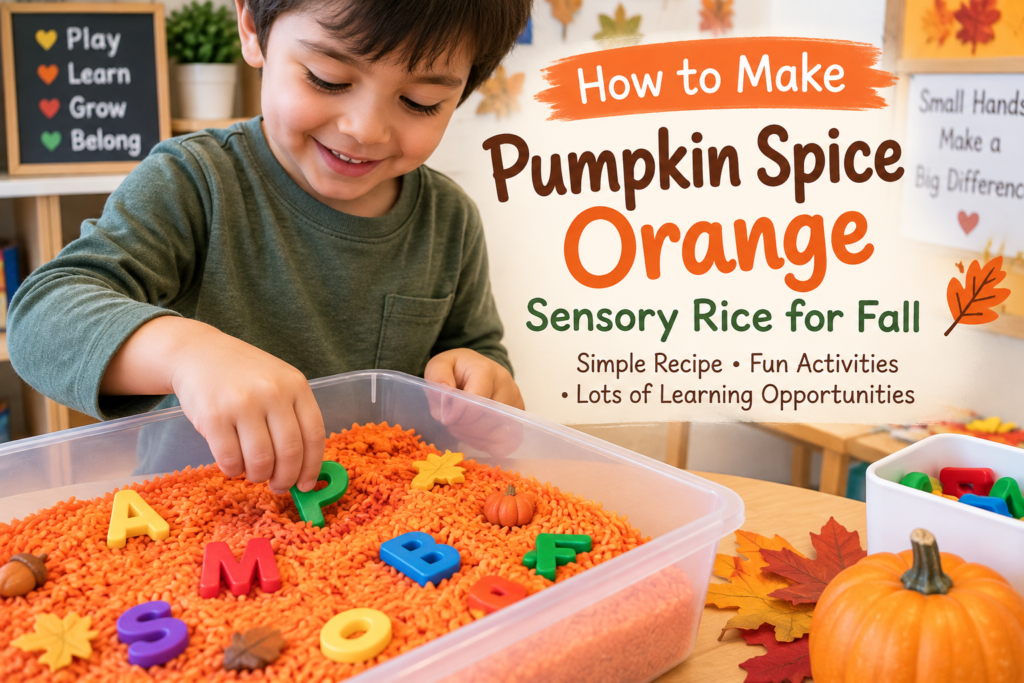
Every fall, I make a batch of orange colored rice to use with my occupational therapy students. It’s inexpensive, easy to make, and can be used for so many different sensory, fine motor, handwriting, and literacy activities.
This year, I’m adding a little pumpkin spice scent to my orange rice. I can have the wonderful smell of fall in my therapy space without actually having to eat anything pumpkin flavored!
Easy Colored Rice Sensory Bin Recipe
I’ve tried different ways of making colored rice over the years, but my favorite method for a sensory bin is white rice + vinegar + food coloring.
It gives you bright, evenly colored rice, dries quickly, and doesn’t leave the rice sticky. It’s also easy to make in big batches, which is important when you’re filling an actual sensory bin!
What You’ll Need
- 4 cups uncooked white rice
- 2 tablespoons white vinegar
- 15–25 drops liquid food coloring, or enough to get the shade you want
- Large zip-top bag or container with a lid
- Parchment paper or a baking sheet
- Pumpkin pie spice or pumpkin spice scent, optional
- Airtight container for storage
How to Make Orange Colored Rice
1. Add the rice.
Put 4 cups of uncooked white rice into a large zip-top bag or container with a tight-fitting lid.
2. Mix the color.
In a small cup, combine 2 tablespoons of white vinegar with 15–25 drops of food coloring.
For fall, I like a nice pumpkin orange. If you don’t have orange food coloring, you can experiment with combining red and yellow until you get the shade you want.
3. Pour it over the rice.
Pour the vinegar and food coloring mixture into the bag with the rice.
4. Shake it up!
Seal the bag and shake, squish, and mix until the color is evenly distributed throughout the rice.
This is actually a fun job for kids, too. All that shaking and squeezing gives them a little extra hand strengthening and heavy work before you even get to the sensory bin.
5. Spread it out.
Pour the rice onto a baking sheet or parchment paper and spread it into a thin layer.
6. Let it dry.
Allow the rice to air dry completely, usually for a couple of hours. Give it a stir once or twice so all of the rice has a chance to dry.
Once it’s completely dry, it’s ready for your sensory bin.
Add a Little Pumpkin Spice 🎃
Here’s where I’m changing up my usual orange rice this year.
I’m adding a little pumpkin spice scent!
If you’re using pumpkin pie spice, wait until the colored rice is almost dry. Sprinkle in a very small amount, stir it through the rice, and then let everything finish drying.
I’d start with only about ¼ teaspoon of pumpkin pie spice for 4 cups of rice. You can always add more, but that pumpkin spice smell can get strong very quickly!
If you’re using a pumpkin spice scent, I’d use the same philosophy: start small. You can always add another drop or two if you want a stronger scent.
And since I’m definitely not president of the pumpkin-flavored-everything fan club, I’ll be keeping mine subtle!
A Note About Scented Sensory Bins
If you’re using your sensory rice with students, scent should always be optional.
Some children love scented sensory materials, while others may find them overwhelming. Consider allergies, sensitivities, sensory preferences, and your school or classroom policies before adding any scent.
There’s absolutely nothing wrong with sticking with plain orange rice. The students will get all the same fine motor and learning opportunities without the added smell.
Making a Bigger Batch
Here’s one thing I’ve learned: 4 cups sounds like a lot of rice until you put it into an actual sensory bin.
If you’re making this for several students or want a nice full classroom or therapy sensory bin, I would make 8–12 cups.
The recipe is easy to double or triple:
- 8 cups rice: 4 tablespoons vinegar
- 12 cups rice: 6 tablespoons vinegar
Then adjust the food coloring until you get the orange shade you want.
I usually prefer making a larger batch at once because I know I’ll use it again and again throughout the season.
Now What Do You Do With All That Orange Rice?
This is where the fun starts!
I love activities that can stay in my therapy space and be used in multiple ways with different students. Change the objects you put into the rice and suddenly you have a new activity without having to create something completely different.
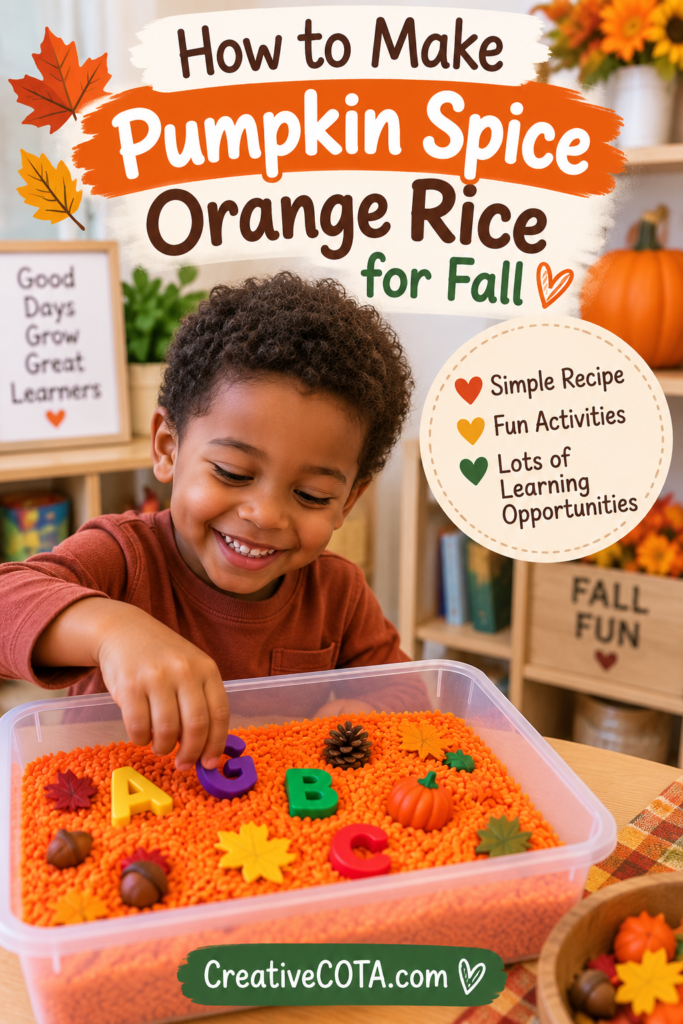
Add magnetic letters, mini erasers, fall-themed objects, scoops, cups, tongs, tweezers, or letter tiles, and you have all kinds of possibilities.
1. Hide Letters in the Rice
Add magnetic letters, letter tiles, or other small alphabet manipulatives.
Students can dig through the rice to find:
- The letters in their name
- Uppercase and lowercase matches
- A letter that makes a particular sound
- Letters needed to spell fall words
- Sight words or spelling words
After finding a letter, students can write it on a dry erase board or paper for a little extra handwriting practice.
Or skip the pencil altogether and use the letters themselves to generate text.
2. Add Fall Mini Erasers
Those little seasonal mini erasers are perfect for sensory bins.
Hide pumpkins, leaves, acorns, apples, or other fall mini erasers throughout the rice. Students can find them with their fingers or use tongs and tweezers for additional fine motor practice.
They can also sort the objects by color, type, size, or another attribute.
3. Scoop and Pour
Sometimes simple is best.
Add small cups, scoops, spoons, funnels, or containers and let students scoop and pour the rice.
This can work on bilateral coordination, grasp, motor planning, hand-eye coordination, and graded control of movement.
And yes, there will probably be rice on the floor. Occupational therapy isn’t always tidy!
4. Use Tongs or Tweezers
Add small fall objects and challenge students to remove them using tongs, tweezers, or clothespins instead of their fingers.
It’s an easy way to work on hand strength, precision, grasp patterns, and fine motor control.
Put small containers next to the bin and students can sort the objects as they find them.
5. Make a Fall I Spy Sensory Bin
Hide a specific number of objects in the rice and give students a list of what they need to find.
For example:
- Find 3 pumpkins.
- Find 2 leaves.
- Find 4 acorns.
- Find 1 apple.
Students can check off each item as they find it.
Now you’ve added visual scanning, counting, attention, and following directions to your sensory activity.
6. Practice Prewriting Strokes
Pour a shallow layer of rice into a tray and use it as a writing surface.
Students can use their finger to practice:
- Vertical lines
- Horizontal lines
- Circles
- Crosses
- Diagonal lines
- Shapes
- Letters
- Numbers
Give the tray a gentle shake and you have a fresh surface to try again.
7. Spell Names, Sight Words, and Fall Words
Hide letters in the rice and have students hunt for the letters they need.
Students can build their names, practice sight words, or create simple fall words such as:
fall, leaf, apple, corn, rake, pumpkin
For students who need more support, provide a visual model of the word and let them search for each letter.
For students ready for more of a challenge, give them a picture and see if they can generate the word themselves.
8. Use It With Alternative Pencils
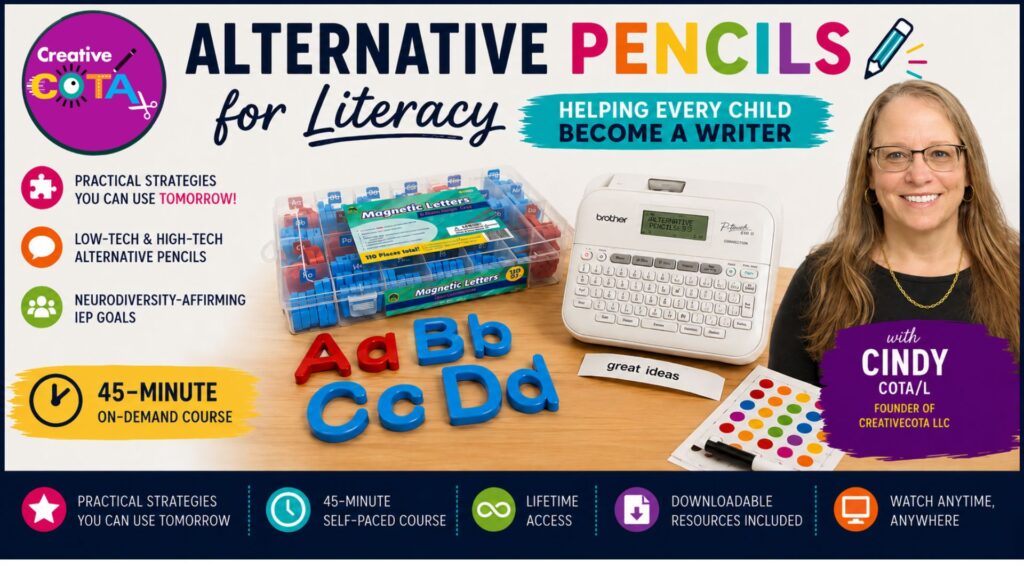
Remember that students don’t have to physically write letters with a pencil to work on literacy.
Students can find magnetic letters or letter tiles in the rice and use them to generate text, build words, answer questions, or create a simple sentence.
This can be especially helpful for students who know more than they’re able to demonstrate through traditional handwriting.
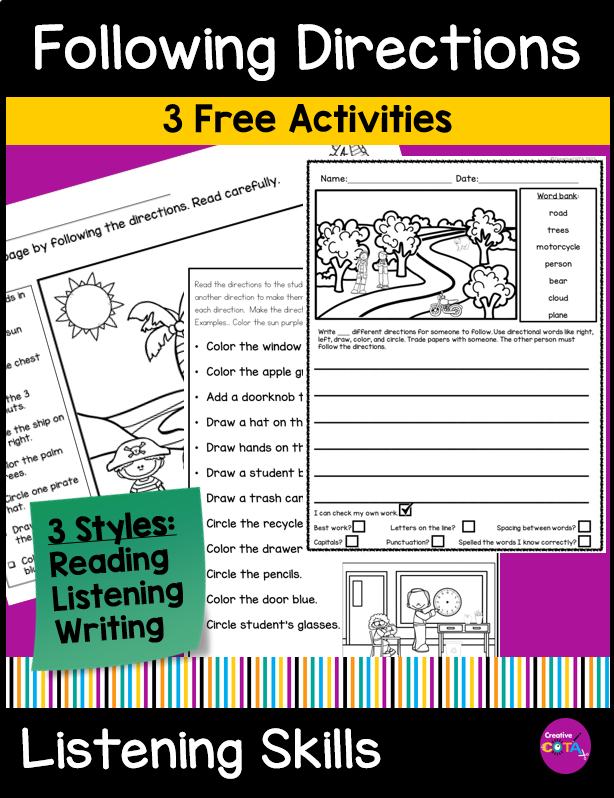
9. Add a Following Directions Activity
Sensory bins are an easy place to sneak in listening and following directions.
Try directions such as:
“Find a leaf and put it in the red cup.”
“Find two pumpkins, then find one apple.”
“Use the tongs to find an acorn and put it beside the pumpkin.”
You can easily adjust the number of steps and concepts based on each student’s needs.
10. Turn It Into a Writing Prompt
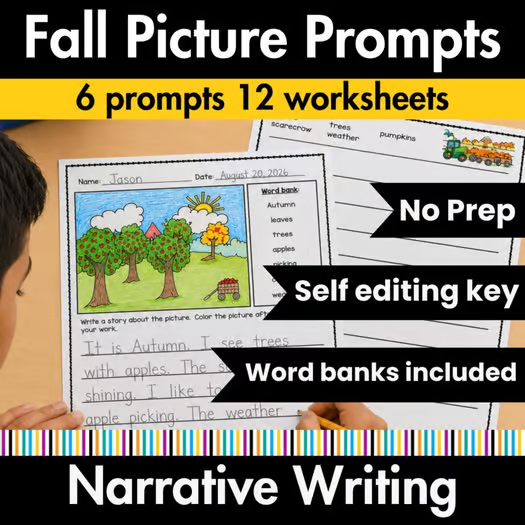
After students explore the sensory bin, use the objects they find to inspire writing.
A student might find a pumpkin, leaf, apple, and squirrel and use those objects to create a sentence or short fall story.
For reluctant writers, having something concrete to look at and manipulate can make generating an idea much easier than staring at a blank piece of paper.
11. Just Let Them Explore
Not everything needs to become a structured activity.
Add scoops, cups, funnels, and a few interesting objects and give students time to simply dig, scoop, pour, search, and explore.
For some students, the sensory experience itself may be exactly what they need.
One Sensory Bin, Lots of Skills
That’s probably my favorite thing about colored rice. I can make one batch and use it over and over again.
Depending on what I add to the bin, my students can work on:
- Fine motor skills
- Hand strengthening
- Bilateral coordination
- Visual motor skills
- Letter identification
- Letter formation
- Prewriting
- Spelling
- Generating text
- Counting
- Sorting
- Following directions
- Attention
- Vocabulary
- Creative writing
And, of course, students also get the sensory experience of digging, scooping, pouring, and exploring.
How to Store Colored Rice
Make sure your rice is completely dry before storing it. Then place it in an airtight container or sealed bag until you’re ready to use it again.
I’ve had colored rice last for years when it’s stored well, which makes the little bit of prep time at the beginning well worth it.
You can pull your orange rice back out every fall and simply change what’s hiding inside it.
An Easy Fall Activity for OT or the Classroom
You don’t need a complicated sensory bin to work on lots of different skills.
A container of orange rice, a few manipulatives you already own, and some scoops or tongs can give you plenty of different fall activities for preschool, kindergarten, elementary special education, and occupational therapy.
Add pumpkin spice if your students enjoy the scent, or leave it unscented for students who prefer fewer sensory inputs.
As for me, I’ll happily enjoy the pumpkin spice smell while continuing to avoid the pumpkin spice coffee!
Amazon Affiliate Disclosure: As an Amazon Associate, I may earn from qualifying purchases.

About the Author
I am a Certified Occupational Therapy Assistant (COTA) and have been working in a public school system for more than 25 years. My resources can be found on TPT, BOOM Learning, Made by Teachers, Classful, and Your Therapy Source. I appreciate your interest, wherever you wish to shop.
I also now have workbooks on Amazon.
My mission is to help you find creative ideas to incorporate fine motor, visual perception, gross motor, and social-emotional learning into your lessons.
I hope you consider signing up for my Free Resource Library with your Email. I send out emails about once a week and share resources, tips, and planning ideas for your classroom or occupational therapy needs. Hopefully, these help your students work on building their skills in a fun and engaging way.
Thank you for your interest in my resources and ideas. I hope you will consider following my journey on TPT or wherever you wish to shop.