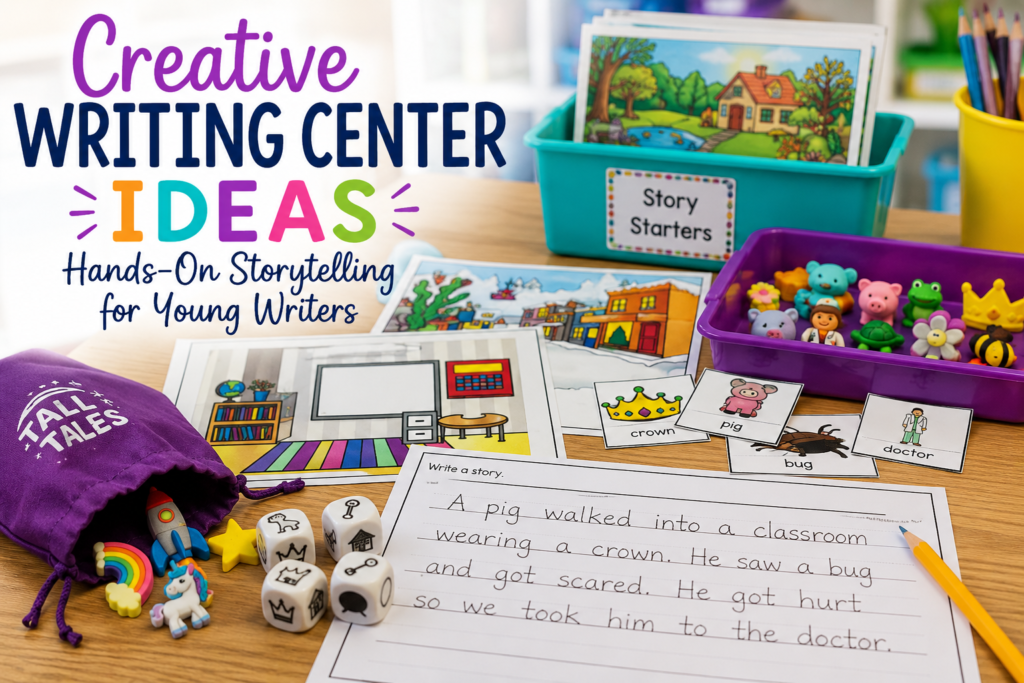
Creative writing can be difficult for young students, especially when they are staring at a blank piece of paper and being asked to come up with a story.
Over the years, I’ve found that many students have plenty of ideas. The harder part is figuring out what to write about, how to get started, and how to turn those ideas into words and sentences.
One of my favorite ways to make writing feel a little less like work is to add something students can see, touch, move, and play with.
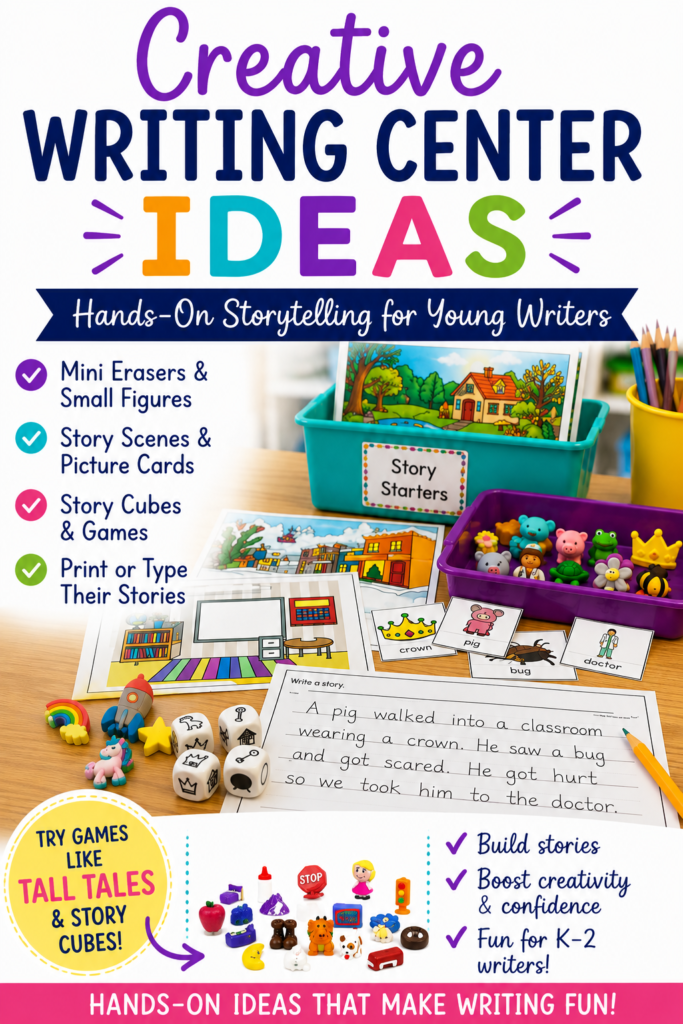
That’s where mini erasers, small resin figures, storytelling games, picture cards, and story scenes come in.
Instead of simply giving students a writing prompt, I like to give them the pieces they need to actually build the story first.
Turn Mini Erasers and Small Figures Into Writing Prompts
Mini erasers are one of those classroom supplies that seem to multiply once you start collecting them. Pumpkins, animals, bugs, food, holiday characters, school supplies, ocean animals…there seems to be a mini eraser for everything.
Small resin figures work just as well and can add even more variety.
Rather than saving them only for counting activities or fine motor centers, try using them for creative writing and storytelling.
Place a handful of mini erasers or figures in a task box and let students choose a few. Those objects become the characters, objects, or problems in their story.
A student might pull out:
- a pig
- a crown
- a bug
- a doctor
Suddenly, there are all kinds of possibilities.
Why is the pig wearing a crown?
Did the bug visit the doctor?
Is the pig the king?
What happens next?
There isn’t one correct story, and that’s part of the fun.
Use Storytelling Games for Even More Creative Writing Ideas
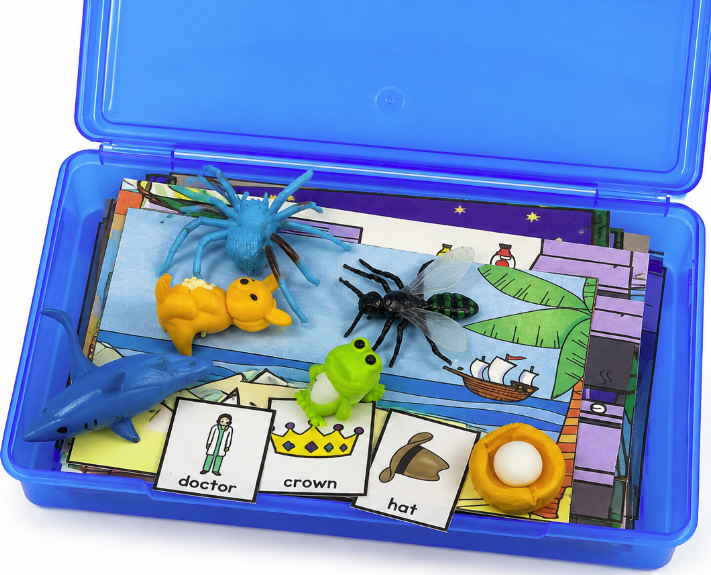
Another easy way to take some of the pressure out of creative writing is to use storytelling games, picture dice, and story cubes. These are especially helpful for students who struggle when they’re simply told, “Write a story.”
Games such as Rory’s Story Cubes, Tall Tales, and eeBoo’s Tell Me a Story cards give students visual ideas they can use to create characters, settings, problems, and events.
I keep activities like these with my other writing center supplies so they’re easy to pull out when a student needs a little extra inspiration.
Tall Tales: Build the Story First
Tall Tales is a storytelling game that works especially well with this approach. The game includes 24 colorful story cards and 50 small game pieces representing different characters and objects.
Students can randomly select pieces, choose a setting, and use them to create a story. Because the activity is based on pictures and objects, students don’t need to be able to read to participate.
They can move the pieces around, act out what is happening, and tell the story orally before deciding how they want to record it.
That’s one of the things I really like about this type of creative writing activity. The student isn’t starting with a blank sheet of paper. They already have characters, objects, and a setting in front of them.
Now they just need to decide what happens.
Try Story Cubes and Picture Dice
Story dice are another simple addition to a creative writing center. Have the student roll several dice and challenge them to include each picture in a sentence or story.
Depending on the student’s ability, you can change the expectations:
- Roll one die and write a sentence about the picture.
- Roll two or three dice and use all the pictures in one silly sentence.
- Roll several dice and create a beginning, middle, and end.
- Take turns rolling and adding the next part of a shared story.
- Roll a character, setting, and object to create a complete writing prompt.
- Tell the story orally first and then write or type it.
Storytelling cards can be used in much the same way. Students can randomly choose several cards, arrange them in an order that makes sense, and then tell or write a story connecting the pictures.
You can also mix the different materials together. Choose a background scene, roll a story cube to determine what happens, and pull a mini eraser from a task box to discover who unexpectedly appears in the story.
Suddenly, a basic writing prompt becomes a hands-on storytelling activity with hundreds of possible combinations.
Create Your Own Hands-On Storytelling Center
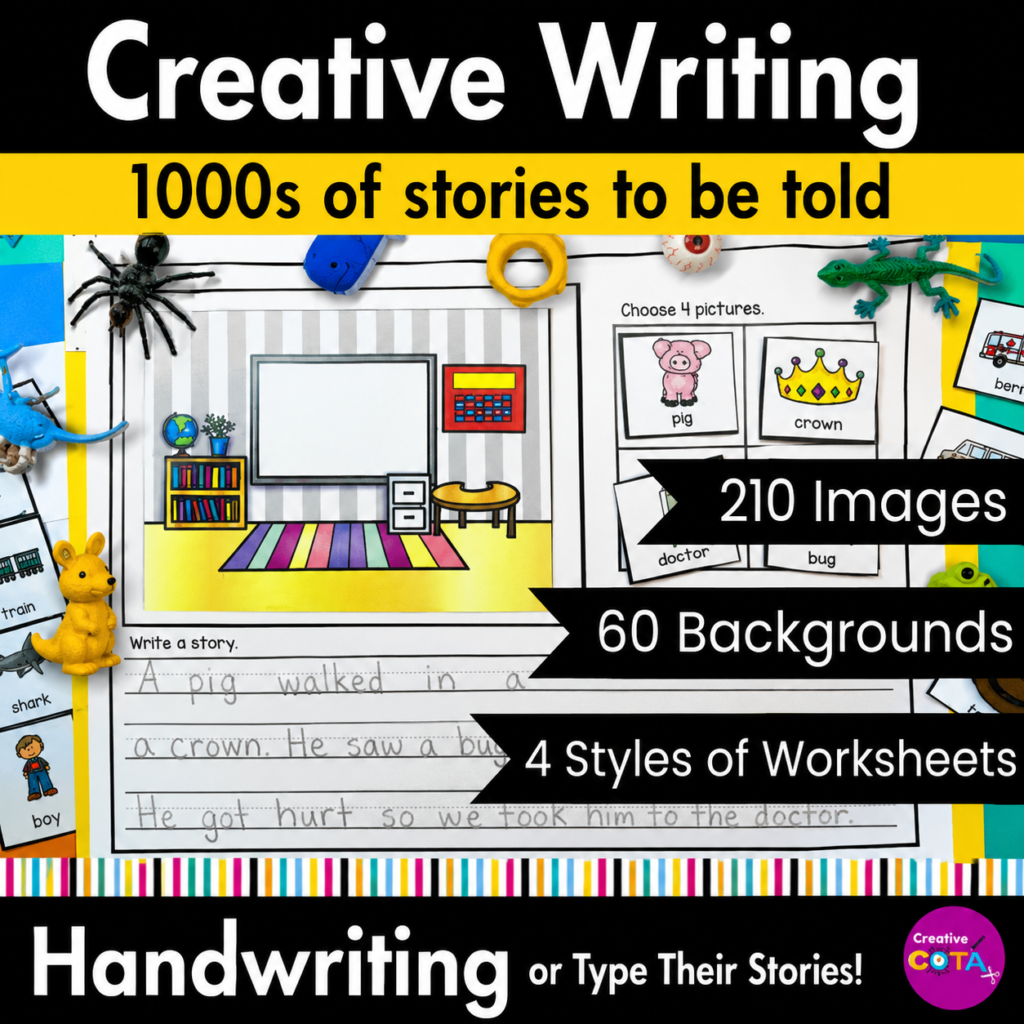
I liked this style of storytelling so much that I used a similar concept when creating my own Creative Writing Story Scenes and Picture Cards resource.
It includes 60 full-color story background scenes and 210 picture cards that students can mix and match to create their own stories.
Students choose a background and then add characters and objects to their scene. They can move the cards around, tell the story aloud, brainstorm keywords, and then use the included writing pages to turn their ideas into sentences or a short story.
There are also vocabulary suggestions for the different scenes to give developing writers a little extra support.
And you don’t have to use only the included picture cards.
Swap them out for mini erasers, resin figures, small toys, storytelling game pieces, or story cubes. You can even let students combine a few of each.
This gives you an easy way to use the same writing center again and again without it feeling like the same activity.
Store Everything in Task Boxes
I love task boxes for activities like these because you can organize everything once and pull it out throughout the year.
You might create boxes for:
- Fall
- Winter
- Animals
- Ocean
- School
- Holidays
- Food
- Community helpers
- Transportation
- Completely random objects
The random box might end up being the most fun!
Inside each box, add mini erasers, small resin figures, storytelling pieces, or other small objects. You can also include story scenes, picture cards, writing paper, and the writing tools your students use.
Students can choose a scene, randomly select two to four objects, and create a story using all of them.
For an even easier setup, put the figures in an opaque container or bag so students can’t see what they are choosing. The unexpected combinations can make for some pretty funny stories.
Use the Same Creative Writing Center All Year
One reason I love this type of writing center is that you don’t have to continually reinvent it.
The routine stays the same while the materials change.
At the beginning of the year, students may simply choose a character and verbally tell you what is happening.
Later, they might write one sentence.
As their skills develop, they can add a problem and solution, sequence several events, or write an entire short story.
You can also use the materials for:
Sentence writing: Choose one or two objects and write a sentence about the scene.
Story starters: Build the beginning of a story and have the student decide what happens next.
Vocabulary: Name and describe the objects before writing.
Sequencing: Act out a beginning, middle, and end before recording the story.
Partner writing: One student chooses the objects and another creates the story.
Silly stories: Require students to use three completely unrelated objects in the same story.
That last one is usually a favorite!
Writing Doesn’t Have to Mean Pencil and Paper
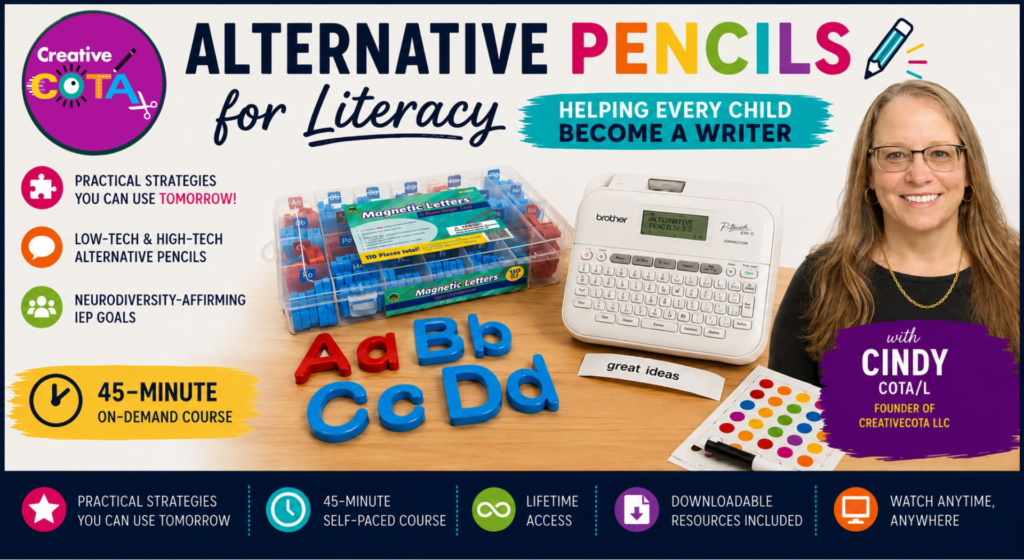
These hands-on storytelling activities are also perfect for using alternative pencils.
A child can have a wonderful story to tell and still struggle with the physical act of handwriting. When handwriting is taking so much effort that the student loses the story they wanted to tell, I want another way for them to get those ideas out.
Depending on the student, I may offer options such as:
- Typing on a keyboard or Chromebook
- Letter stamps
- Magnetic letters
- A label maker
- AAC
- Voice-to-text
- A scribe
The goal of a creative writing activity should be to give students opportunities to generate text and communicate their ideas, not simply to see how much handwriting they can tolerate.
I talk much more about this in my Alternative Pencils for Literacy: Helping Every Child Become a Writer course. It includes practical ways to introduce alternative pencils, set them up in classrooms and writing centers, and help students find a writing method that works for them.
These story scenes work especially well with alternative pencils because students already have a visual idea in front of them. They can focus on turning that idea into language without having to simultaneously invent a topic and manage a difficult motor task.
What About Handwriting Practice?
There is still plenty of room for handwriting.
For students who are working on handwriting skills, the included writing pages provide an opportunity to practice writing words, sentences, or a short story.
I just like to separate the two goals when needed.
Sometimes we’re practicing handwriting.
Sometimes we’re practicing storytelling and generating text.
And sometimes we can work on both at the same time.
Giving students different ways to participate makes the same writing center useful for a much wider range of learners.
My Favorite Creative Writing Games and Accessories
You don’t need a huge collection of supplies to create a hands-on writing center. Start with a few things and add to it over time.
I’ve put together a Creative Writing Games & Accessories list in my Amazon storefront with some of my favorite supplies for these activities, including story cubes, storytelling games, mini erasers, small figures, and other accessories that can help students generate ideas, build stories, and practice sentence writing.
Once you have a small collection, sort the pieces into task boxes and rotate them throughout the year. Even 10 or 15 little objects can create an incredible number of story combinations when students randomly choose a few at a time.
Pair them with visual backgrounds and you have a writing center that can be used again and again for creative writing, narrative writing, sentence writing, storytelling, handwriting, vocabulary, sequencing, keyboarding, occupational therapy, and special education activities.
Best of all, students aren’t starting with a blank page.
They have something to touch.
Something to move.
Something to talk about.
And, before they know it, they have something to write about too.
About the Author
I am a Certified Occupational Therapy Assistant (COTA) and have been working in a public school system for more than 25 years. My resources can be found on TPT, BOOM Learning, Made by Teachers, Classful, and Your Therapy Source. I appreciate your interest, wherever you wish to shop.
I also now have workbooks on Amazon.
My mission is to help you find creative ideas to incorporate fine motor, visual perception, gross motor, and social-emotional learning into your lessons.
I hope you consider signing up for my Free Resource Library with your Email. I send out emails about once a week and share resources, tips, and planning ideas for your classroom or occupational therapy needs. Hopefully, these help your students work on building their skills in a fun and engaging way.
Thank you for your interest in my resources and ideas. I hope you will consider following my journey on TPT or wherever you wish to shop.
This post contains affiliate links. As an Amazon Associate, I earn from qualifying purchases at no additional cost to you.