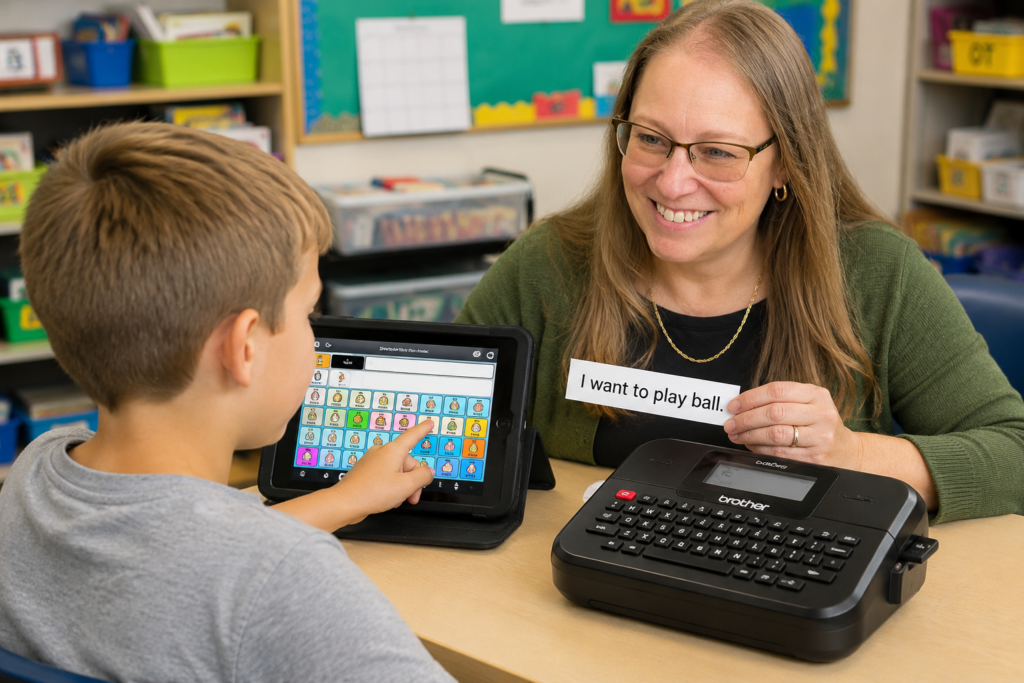
For years, many occupational therapy IEP goals have focused on one thing: writing with a pencil.
Goals often read something like:
“The student will write a sentence…”
“The student will write their name…”
While handwriting is an important life skill, we began asking ourselves an important question as an occupational therapy department:
Are we measuring handwriting, or are we measuring a student’s ability to communicate?
That one question led us to make a simple but meaningful change in many of our IEP goals. Instead of using the word write, we began using the phrase generate text.
It may seem like a small wording change, but it has opened up many more opportunities for our students to participate in literacy while still supporting handwriting development.
Why “Generate Text” Matters
When we hear the word write, most of us immediately picture a student holding a pencil. But writing is much bigger than pencil and paper. Students communicate in many different ways.
They may:
- Handwrite with a pencil or marker
- Type on a keyboard
- Use voice-to-text
- Communicate with an AAC device
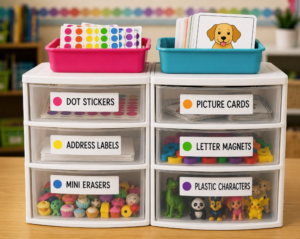
- Build words with magnet letters or letter tiles
- Use a label maker
- Create stories using apps like Book Creator
Each of these methods allows students to generate text and communicate meaningful ideas. By focusing on the outcome rather than the tool, we can better support students with a wide range of strengths and learning styles.
Handwriting Still Matters
Making this shift doesn’t mean we stop teaching handwriting. In fact, our occupational therapy department continues to work on handwriting with many of our students every day.
Handwriting remains an important functional life skill.
What changes is that handwriting is no longer the only way students can participate in literacy instruction or demonstrate what they know.
Students don’t have to wait until handwriting becomes easy before they begin thinking like writers.
They can answer questions, tell stories, write opinions, and participate in classroom writing activities while we continue supporting fine motor development.
Teaching Students to Choose the Right Tool
One of the biggest benefits of this approach is that it teaches executive functioning and self-advocacy.
Instead of choosing the writing tool for students, we can teach them how to evaluate the task and decide which tool will help them do their best work.
For example:
- Filling in a blank or writing one word? A pencil may be the quickest choice.
- Writing a sentence? A keyboard or label maker may help organize thoughts.
- Writing several sentences or a paragraph? Voice-to-text may reduce fatigue and allow students to focus on communicating ideas.
This is exactly what adults do every day.
We choose between handwriting, typing, dictating, texting, or using digital tools depending on the task.
Helping students learn this decision-making process prepares them for school, work, and everyday life.
Sample Neurodiversity-Affirming IEP Goals
Here are three examples of goals our occupational therapy department has found helpful.
Goal 1: Generate Text
**By ____________, given instruction, practice, access to self-regulation supports, and available writing tools and technology, the student will generate text (e.g., handwriting, keyboarding, voice-to-text, AAC device, magnet letters, label maker, letter tiles, or other appropriate tools) to communicate an intended message with 80% accuracy in 2 out of 3 opportunities as measured by therapist observation, collected work samples, and data collection.
Goal 2: Selecting the Appropriate Writing Tool
**By ____________, given instruction, visual supports, access to self-regulation tools, and a variety of writing options, the student will independently evaluate the writing task and select the writing method that best matches the task and their individual needs (e.g., handwriting, keyboarding, voice-to-text, AAC device, label maker, magnet letters, scribe, or other alternative pencils) to generate text with an intended message with 80% independence in 2 out of 3 opportunities as measured by therapist observation, collected work samples, and data collection.
Goal 3: Building Fine Motor Skills Through Multiple Writing Methods
**By ____________, given access to sensory, emotional, and executive functioning supports (e.g., movement breaks, fidget tools, visual schedules, visual to-do lists, alternative seating, extra time and space, access to a quiet environment, and incorporating the student’s interests), and access to a variety of writing and drawing tools (e.g., markers, crayons, letter stamps, whiteboards, Magna Doodle, iPad letter apps, keyboarding, playdough and tools, magnet letters, label makers, and other alternative pencils), the student will demonstrate improved fine motor skills by writing, typing, constructing, or creating the letters of their first name from a model in 2 out of 3 opportunities as measured monthly by therapist observation, collected work samples, and data collection.
Each of these goals supports literacy while allowing flexibility in how students participate.
A Shift in Thinking
One sentence has guided our occupational therapy department throughout this work:
The goal shouldn’t define the tool. The goal should define the outcome.
Our outcome is meaningful communication.
The tool is simply how the student gets there.
When we focus on communication instead of one specific writing method, we create more opportunities for students to participate, demonstrate what they know, and experience success.
Final Thoughts
Alternative pencils do not replace handwriting instruction.
They expand access to literacy.
They encourage participation.
They support executive functioning and self-advocacy.
Most importantly, they remind us that there is more than one path to becoming a writer.
Our goal isn’t just to teach students how to use a pencil.
Our goal is to help every child become a writer.
Want to Learn More?
If you’re interested in practical strategies for using alternative pencils in the classroom or therapy setting, check out my Alternative Pencils for Literacy: Helping Every Child Become a Writer professional development course.
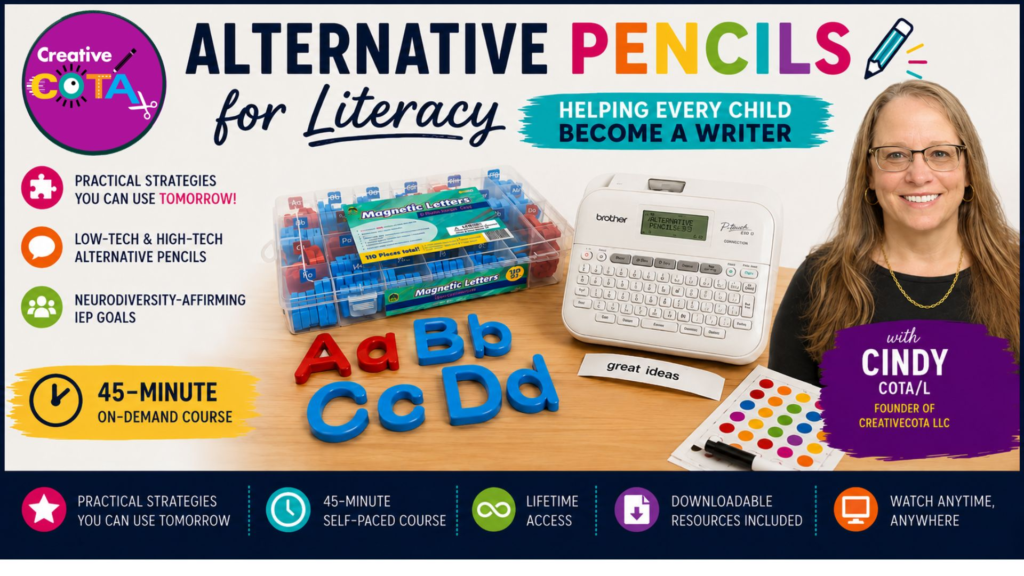
In this on-demand workshop, I share real classroom examples, low-tech and high-tech alternative pencils, student success stories, and practical ideas you can begin using immediately.
Because students get more accomplished when it doesn’t smell like work.
Cindy Femenella, COTA/L
Founder & CEO, CreativeCOTA L